

 English
 العربية
 Español
 Русский
Industry News
Industry News

A construction site is one of the harshest environments any piece of equipment will ever face — dust, heat, vibration, and unpredictable load swings. Choosing the right construction site diesel generator set can make the difference between a project that finishes on time and one that bleeds money through unplanned downtime. This guide walks contractors, project managers, and procurement officers through everything you need to know before buying a diesel power generator for a job site: how to size it, which type to pick, which features matter, and how to evaluate a China diesel generator manufacturer as a sourcing partner.
Job sites rarely have grid power available when you need it. Even when the local utility offers a temporary connection, lead times of 30 to 90 days, expensive connection fees, and the risk of brown-outs under heavy load mean most contractors prefer to bring their own power. A diesel genset for construction is the workhorse of choice because diesel fuel is widely available, diesel engines tolerate dust and heat better than gasoline units, and export-rated diesel generators like the 40kW model are designed specifically to be moved between sites without warranty penalty.
Beyond running tower cranes, concrete mixers, and welders, a modern job-site generator often powers site offices, lighting towers, security systems, and worker accommodation blocks. In other words, the generator isn't a single-tool accessory — it is the central nervous system of the entire project. Specifying the wrong unit creates cascading losses: trip-damaged tools, spoiled concrete pours, missed deadlines, and in hot climates, real safety risks from heat stress in unventilated site offices.
This is also why an increasing number of contractors are moving away from cheap open-frame consumer sets and toward industrial 100kW silent diesel generators or dedicated qualified backup power units built for continuous duty rather than emergency use.
Undersizing a generator is the most common mistake buyers make. They look at the nameplate of their largest tool — say, a 30kVA welder — and assume a 30kVA set will do the job. In practice you need to add up running loads and starting (inrush) loads separately, then apply a safety margin of at least 20%.
Walk the site and itemize every electrical load — tower light (1kW each), site office air-conditioner (1.5–2.5kW), hoist motor (5–15kW), welding machine (8–30kVA), rebar bender, water pump, dewatering pump, survey instrument chargers, security CCTV, site internet. Don't forget small things: phone chargers, kettles, microwave ovens in the worker canteen.
Electric motors draw 3 to 7 times their rated current for the first few seconds. A 15kW hoist motor may need 60–80kW of generator capacity purely to start. If multiple motors start simultaneously, the surge adds up. A 100kW silent generator such as Longhong's 100kW Cummins/Weichai silent diesel generator set is often the sweet spot for medium-sized commercial builds because it gives you enough headroom for typical motor inrush.
Construction sites grow. New subcontractors arrive, an extra floor is added, the lighting count doubles for night shifts. Sizing today's load at exactly 100% generator capacity leaves no room for tomorrow. Experienced procurement teams always specify one size up — for example, a 80kW trailer generator instead of a 64kW set, or a 80kW silent diesel generator for projects sized around 50–60kW continuous load.
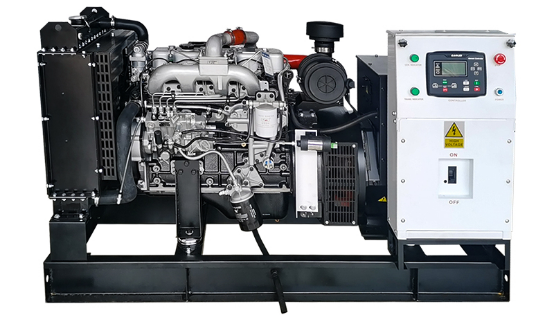
Construction sets come in four physical formats. Each has clear strengths, and most large contractors keep more than one type in their fleet.
Open-frame sets are the cheapest format because they have no enclosure — just the engine, alternator, base frame, fuel tank, and a control panel. They are ideal for large civil projects (highways, ports, mines) where the set is sited inside a fenced compound away from workers. For a deep dive into mining and quarry applications, see our earlier piece on a Weichai diesel generator running at 5,300m altitude in a mining area.
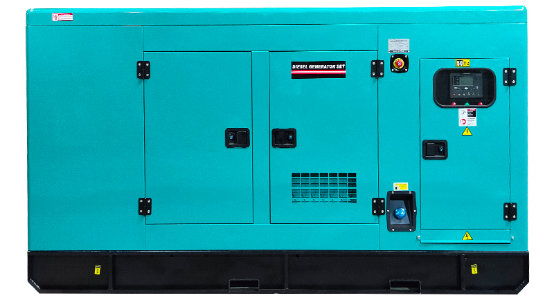
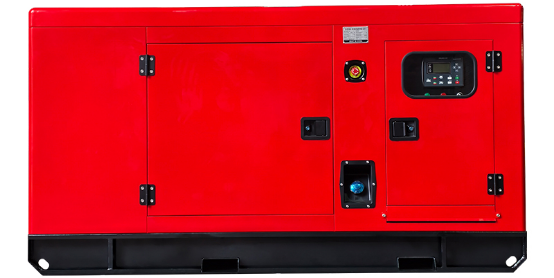
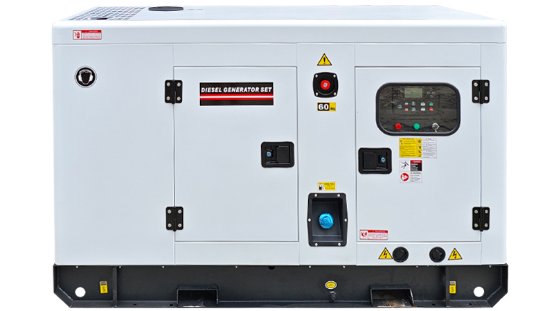
Silent canopy sets wrap the engine in a sound-attenuated steel enclosure lined with fire-resistant acoustic foam. They typically keep noise below 75 dB(A) at 7 meters, which meets most urban night-work regulations. A 32kW silent diesel generator or a 20kW silent canopy generator is the typical pick for residential infill sites, school renovations, and hospital upgrades where municipal noise limits apply.
Trailer-mounted sets are the most flexible. They bolt the generator set onto a road-tow trailer with brakes, a jockey wheel, and lighting. A single operator can hitch a trailer type construction site generator to a pickup truck and move it between phases of a road project in an afternoon. For high-power mobile applications, the 400kW/500kVA silent trailer generator referenced in our 400KW Yuchai silent trailer case study shows how trailer format scales into the utility-class range.
Containerized sets are essentially 20ft or 40ft ISO container enclosures housing a large prime-rated generator (often 1000kVA+). They are common on mega-projects, large data-center builds, and remote industrial plants where the unit ships overseas pre-commissioned and is dropped onto a hardstand by crane. For long export shipments, container format is also the safest way to protect the unit from salt-spray corrosion on the deck of a cargo vessel.
The trailer-vs-stationary decision is less about raw power and more about how you intend to deploy the unit.
Multi-phase projects where the load center moves every 30 to 90 days (highways, pipelines, transmission lines).
Rental fleet use — every extra hour the unit is on a customer's site is billable.
Remote sites with no permanent hardstand; the trailer's own wheels handle soft ground better than a forklift-moved skid.
International export jobs where the generator needs to be road-legal in the destination country.
Single-site projects lasting 12 months or more (high-rise builds, large industrial plants).
Hospital, data-center, or hotel standby installations where the generator lives inside a dedicated plant room.
Acoustically sensitive inner-city sites where the stationary set is dropped inside a masonry acoustic enclosure.
Prime-rated continuous-duty applications such as Libya 750kVA Cummins export power plant-style installations.
For most mid-sized contractors running 3 to 8 active jobs per year, a small mixed fleet — say, one trailer-mounted 80kW set and one stationary 100kW silent unit — offers the best balance of flexibility and capital efficiency.
Two generators with identical kilowatt ratings can behave very differently on a job site. The difference is in the spec sheet details that buy-and-forget buyers tend to skim past.
Engine choice determines long-term cost of ownership. Cummins, Weichai, Yuchai, Perkins, Volvo, and Yunnei are the six engine families most commonly spec'd in China diesel generator manufacturing. Cummins and Perkins carry a global service footprint; Weichai, Yuchai, and Yunnei offer excellent value with strong service networks across Southeast Asia, Africa, and the Middle East. Make sure the brand you pick has distributor coverage in the country where your project is based — a generator that cannot be serviced in-country is a liability.
Job sites are dusty by definition. Look for an alternator and control panel rated at least IP23, ideally IP54 for canopy sets. IP54 protection means the enclosure resists both dust ingress and splashing water — critical when the set sits through weeks of monsoon rain.
An auto-start module watches the incoming mains supply. The instant mains power fails, the controller starts the engine, brings it to rated speed and voltage, and signals the ATS (Automatic Transfer Switch) to switch the load. Total transfer time is typically 8 to 12 seconds — fast enough for site servers, lift controls, and security systems to ride through. For an introduction to how these modules wire into larger standby systems, see our guide on 64kW automatic diesel generators.
Open-frame sets often ship with an 8-hour base tank; silent canopies typically integrate a 6–12 hour tank inside the skid. For sites far from fuel supply, specify an enlarged belly tank (24h or 48h run-time) or an external day tank with bunding. Bunding — a 110% capacity containment tray under the tank — is mandatory in many jurisdictions for environmental compliance.
Ask the supplier to ship a recommended spares list with the unit: oil filters, fuel filters, air filters, a set of belts, a bottle of coolant, and at least one spare injector. A 12-month or 1,000-hour warranty is industry standard; premier suppliers like Guangdong Longhong Electromechanical Equipment Co., Ltd. also offer extended warranty packages with on-site commissioning.
One of the first questions every buyer faces is whether the site needs a single-phase diesel generator or a three-phase diesel generator. Pick the wrong one and either half your tools won't run or you've spent double what you needed to.
Single-phase 220–240V is the standard for residential builds, small retail fit-outs, site offices, and lighting-only applications. A 10–14kW single-phase silent generator is the right format for these jobs. Compact units like the 10–14kW silent diesel generator weigh in around 350–500kg and can be craned into a basement plant room without breaking out a permit.
Any motor rated above about 2.2kW (3hp) — for example, an elevator, a large air-conditioner, a tower crane, or an industrial hoist — virtually always needs three-phase 380–415V supply. Commercial and industrial sites should therefore standardize on three-phase generators from the start. Most 16kW, 24kW, and 30kW silent diesel generators are available in both single-phase and three-phase variants, so check the spec sheet carefully before paying.
When a generator feeds both three-phase motors and single-phase office loads, unbalanced phase loading can cause voltage instability and trip the alternator. Distribute single-phase loads as evenly as possible across the three phases at the distribution board; in extreme cases, fit a phase-balancing transformer or specify an oversized alternator with a winding tolerant of 30%+ imbalance.
Sourcing a diesel generator set from a Chinese factory can cut capital costs by 30–50% versus equivalent European or American brands — provided you vet the supplier carefully. Here is the short list that experienced international buyers run through.
CE marking (mandatory for the EU and most of the Middle East) and ISO 9001 quality management are the baseline. For African and Southeast Asian markets, SONCAP, PVOC, and SNI certifications may also be required. Always confirm certifications are issued by an accredited body, not a self-declared sticker on the control panel.
The two biggest cost components in any generator are the engine and the alternator. Genuine suppliers use engines with traceable serial numbers and copper-wound alternators (not aluminium). Insist on the engine brand's official warranty card and the alternator nameplate photo before shipment.
Every reputable Chinese diesel generator source factory runs a 0%, 25%, 50%, 75%, and 110% load test on every unit before shipping. Request a video of the test reading the kW, frequency, voltage, and oil-pressure gauges. Insist on hi-res QC photos of the controller, the canopy interior, the wiring harness, and the rating plate. For a real example of an export-ready build, see our Tanzania 100kVA Cummins export project.
Lead time is the silent killer in construction procurement. Suppliers with 200+ units of permanent stock — like Longhong's 3kVA to 3000kVA range — can typically dispatch standard configurations within 7 to 14 days. Customized builds (special paint, non-standard ATS, extended tank) may push lead time out to 30–45 days. Plan the procurement schedule around the longest-lead item on the bill of materials.
Ask whether the supplier sends an engineer to site for commissioning, or whether commissioning is handled remotely by phone and video. For overseas projects, on-site commissioning is gold-standard; remote commissioning is acceptable for experienced local electricians. Either way, a proper operation-and-maintenance manual in the language of the destination country is non-negotiable.
A construction site diesel generator set is too important to be left to the last week of project planning. By mapping out the load list, calculating true inrush demand, picking the right physical format (open, silent, trailer, containerized), and choosing a qualified China diesel generator manufacturer with traceable components, you protect both your schedule and your budget. Whether you need a compact 10–14kW silent set for a small renovation, a 100kW silent canopy generator for a mid-rise build, or a trailer-mounted 80kW unit for a multi-phase infrastructure project, the same disciplined selection process applies.
Plan the power first. The concrete, the welds, and the workers will thank you for it.


