

 English
 العربية
 Español
 Русский
Industry News
Industry News

A school makes a promise to every parent who walks through the gate: the children are safe here. A university makes a parallel promise to its students and researchers: the labs, the servers and the schedules hold. When the grid fails during a school day, both promises come under pressure at once — corridor lights go dark mid-lesson, fire alarm panels drop to battery, computer labs and admissions servers shut down, and kitchen cold storage begins its slow climb toward unsafe temperatures. That is why a properly specified standby diesel generator has become standard equipment on campuses worldwide, from rural primary schools to multi-building university districts. This guide walks school business managers, campus engineers and contractors through the complete buying decision: which loads a campus must carry during an outage, how to size the diesel generator set, how to keep it quiet enough for classrooms, and how to source reliably from a factory. Guangdong Longhong Electromechanical Equipment Co., Ltd., a China diesel generator manufacturer with more than 20 years of experience, builds diesel power generator solutions from 3 kVA to 3,000 kVA — including the 500 KVA silent unit it delivered to a working school campus.
Education facilities sit at an awkward intersection of risks: high occupant density, strict duty-of-care obligations and loads that quietly grow every year as teaching goes digital. An emergency diesel generator is the equipment that keeps those risks manageable when the utility cannot.
The immediate losses are the visible ones: lessons stop in windowless classrooms, networks go down, and administration loses access to student records and payment systems. The expensive losses are less obvious. Science laboratories depend on ventilation — a fume hood that stops extracting while students are still working is a genuine chemical-safety incident. Kitchen freezers hold a full week of catering stock. Boarding-school dormitories lose lighting, water pressure pumps and, in winter or tropical heat, the HVAC that keeps rooms habitable. University campuses add research freezers holding years of samples and data rooms running the learning platform. A diesel genset that starts automatically turns all of these from incidents into non-events; a school that waits for the grid absorbs the cost of each one separately.
Building and fire codes in most jurisdictions treat schools as assembly occupancies, which means certain systems must keep working in an outage: emergency and escape lighting, fire alarm and detection panels, public-address and evacuation systems, and often fire pumps and elevators designated for accessibility. These life-safety loads define the floor of any campus generator specification — no matter how small the school, the power outage backup power generator must at minimum carry them, and it must start fast. Automatic transfer within about 10 seconds is the common benchmark for emergency loads, which is why manual-start portable units rarely satisfy the requirement and a true auto-start diesel generator with an ATS is the practical answer. Check the local code with your fire authority before finalizing the specification, because required coverage varies by region and building age.
A campus is not one load — it is a stack of loads with different consequences when interrupted. Sorting them into tiers before sizing prevents both dangerous undersizing and wasteful oversizing, and it gives the school a rational plan for which buildings stay powered in a prolonged outage.
Tier one is life safety: emergency lighting, fire alarm, PA, door access, and where required the fire pump. Tier two is critical academic and operational load: server and network rooms, laboratory ventilation, research freezers, kitchen refrigeration, water and sewage pumps, and dormitory essentials in boarding schools. Tier three is deferred load: general classroom lighting and power, sports-hall ventilation, offices — valuable for continuity but able to wait out a short outage. Map every building against these tiers and total the connected watts of each; the result drives the generator rating, the transfer-switch scheme and whether one central set or several distributed sets makes sense. Present this tier map to your diesel generator supplier with the enquiry — a supplier who asks for it unprompted is a supplier who understands institutional work.
School loads are motor-dominated: rooftop HVAC units, chilled-water pumps, booster pumps, kitchen compressors and — the largest single motor on most campuses — the fire pump. Every motor draws several times its running current at startup, and the generator must absorb that inrush without excessive voltage dip, or computers will reboot precisely when the lights come back on. Note the starting method of each large motor: direct-on-line start needs the most generator capacity, star-delta less, and soft-starters or variable-frequency drives least. If the fire pump is carried by the standby set, most standards require the generator to accept its starting load with margin — confirm that calculation in writing from the manufacturer. This is the same discipline behind any industrial emergency diesel generator installation.
With the tier map and motor list in hand, sizing follows a short, disciplined sequence — and worked examples for a small school and a boarding campus show how differently it can land.
First, total the tier-one life-safety load — this is non-negotiable capacity. Second, add tier-two critical load with its motor-starting increments. Third, decide the tier-three coverage policy: small schools usually carry everything, while large campuses often back up tier three only in selected buildings, which may mean several smaller generators instead of one large one. Fourth, add a 20% growth margin — schools add air-conditioned classrooms, digital whiteboards and security cameras every year. Fifth, convert the running load to kVA at 0.8 power factor, verify the worst motor-start transient, and settle the electrical format: most campuses need a three-phase diesel generator at 380/400 V 50 Hz (or 220/380 V 60 Hz in some export markets), while a single small building may suit a single-phase diesel generator. Finally, check the duty rating — a set that starts a few times a month is standby-rated, which keeps cost sensible.
Consider a rural primary school: emergency lighting, alarm and PA total about 4 kW; a computer room, small kitchen refrigeration and a water pump add about 10 kW with modest starting increments; classroom lighting and fans add 8 kW. With growth margin the requirement lands near 26 kW — about 33 kVA — a textbook fit for the 32 kW silent generator class, compact enough for a small plant room and quiet enough to run beside a classroom block.
Now a boarding campus: dormitory and corridor lighting 20 kW, kitchen refrigeration and cooking support 15 kW, water and sewage pumps 12 kW, server room and admin 10 kW, workshop and laundry 8 kW — roughly 65 kW running once motor increments are included, and 78 kW with growth. That lands at about 98 kVA, the territory of the 80 kW silent diesel generator to 100 kW diesel generator band; Longhong itself commissioned a 500 KVA silent unit for a school campus where the electrical scope also covered sports and event facilities. Large university districts scale further into central energy plants, where multiple containerized diesel generator sets run in parallel as a small diesel power plant serving the whole estate.
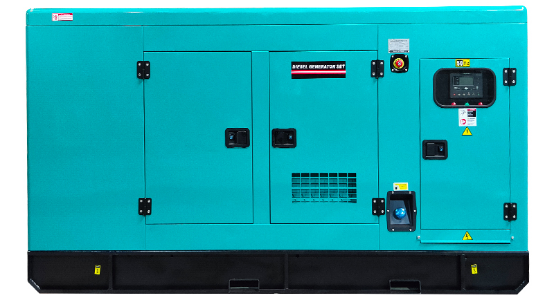
Schools have a noise problem most industrial buyers never face: the neighbors are children in classrooms trying to listen to a teacher, and the generator must be able to run a full school day during an outage without defeating the purpose of the school.
A quality canopy diesel generator holds output near 65–75 dB(A) at 7 meters; super-silent variants go lower. On a compact campus, distance is free attenuation — every doubling of distance from the plant room cuts perceived noise sharply — so position the set away from classroom façades and toward service yards, with the exhaust oriented away from teaching wings. On larger estates, several smaller silent sets distributed across the campus often beat one large central plant on both noise and cabling cost. Verify the canopy's cooling performance at full load before signing — an enclosure that quiets the machine by starving its airflow will derate the set on a hot afternoon when every classroom air-conditioner is running.
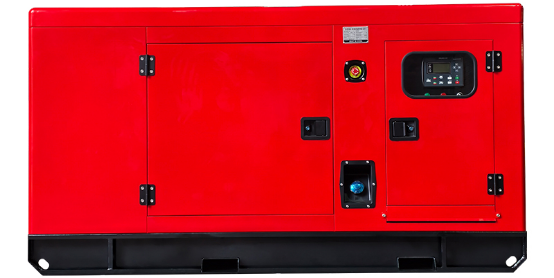
Campus installations are permanent infrastructure, so specify them like it: a reinforced concrete pad with vibration isolators, Louvre ventilation sized to the radiator, and rain hoods for monsoon climates. Fuel storage should carry at least 24–48 hours at expected outage load — an oversized base tank usually serves small schools, while larger campuses add external day tanks with bunded containment that satisfies local fire rules. Security matters on education estates: lockable canopies, raised air intakes and tamper-resistant fuel caps protect both the machine and the students around it.
A campus generator that works is one nobody noticed. Achieving that record depends on the control system and, just as much, on a testing rhythm that respects the school calendar.
The automatic transfer switch monitors the mains, signals the generator to start when voltage drifts out of tolerance, and moves the load once output is stable — typically restoring power within about 10 seconds, fast enough that computers ride through on their power supplies and fire panels barely register the event. Factory-integrated packages such as the 64 kW automatic diesel generator ship with matched controller, battery charger and transfer hardware, removing the integration risk of mixing control brands — a real consideration for school maintenance teams of two or three people.
Standard practice is a weekly no-load or light-load test run — many schools run theirs Wednesday mornings — plus an annual full-load test, ideally with a load bank if the building loads cannot safely carry it. Schedule the annual test for the holiday between terms: a generator discovered faulty during exam week is a leadership problem as much as an engineering one. Align preventive service with the same calendar — coolant, belts, batteries and filters serviced before each term starts — and keep the logbook the fire inspector will ask for, because in most jurisdictions the emergency power system's test records are part of the school's safety compliance file.
Not every education project is a campus. Kindergartens, rural primary schools, training centers and single university buildings each justify their own smaller, simpler package — and matching the rating to the building is where cheap oversizing or dangerous undersizing usually happens.
A kindergarten or training center with alarm, lighting, a computer room and refrigeration typically lands at the 24 kW silent diesel generator class. Rural primary schools and health rooms on the same plot suit the 32 kW class discussed above. Remote classrooms, guard houses and small server rooms — where only essentials must survive an outage — match the compact 10–14 kW silent generator, which installs on a small pad and runs on a modest fuel budget. For international schools following British electrical standards, order the UK diesel genset configuration at 230/400 V, 50 Hz with UK-socket options; for Latin American education networks, the equivalent "generator electrico" at local voltage and 60 Hz is confirmed at the factory before production.
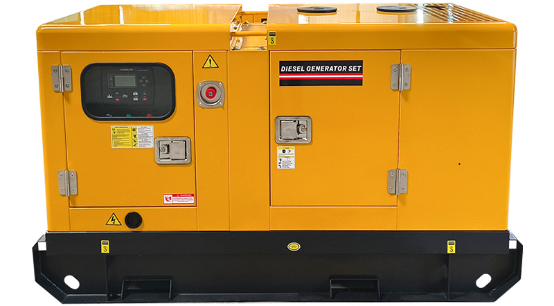
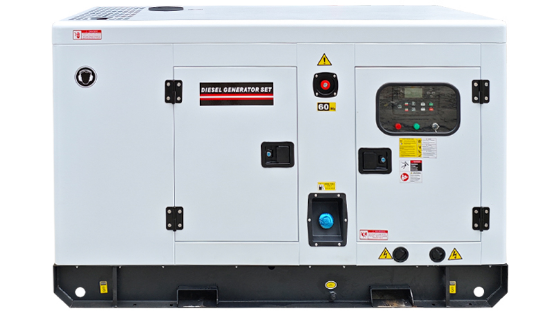
Education estates also host temporary demands: graduation ceremonies on the sports field, exam halls in tents, and renovation phases when a building's permanent supply is cut over. A mobile trailer diesel generator or portable canopy unit covers these jobs and doubles as a contingency set — but for life safety, that role belongs to the fixed, auto-start installation.
Education procurement is value-driven by nature, and China produces more diesel generator set equipment than any other country. The right diesel generator factory converts that value advantage into a dependable institutional asset — the wrong one converts it into a maintenance story. The difference is visible in the specification and test process.
Write the enquiry around facts, not adjectives: the tiered load list with motor-starting increments, voltage and frequency, enclosure noise target, fuel autonomy target, site altitude and ambient temperature, and the ATS/control scope. Insist on genuine, nameplate-verifiable engines — Longhong builds with Cummins, Weichai, Yuchai, Perkins, Volvo and Yunnei engines matched to copper-wound alternators — and require the alternator brand and winding data in writing, because the alternator is where low-cost sets quietly cut the most value. A credible diesel generator supplier returns a sizing calculation that shows the worst motor-start case accepted, not a one-line quotation.
Require a factory acceptance test on your actual units — rated-load run, 110% overload check, voltage and frequency regulation, ATS function — documented with video or third-party inspection, and verify CE and ISO certification on the manufacturer's qualifications page. Then ask for references in your own sector: Longhong's 500 KVA silent generator installed at a school is exactly the evidence an education buyer should demand, because campus work proves both the acoustic engineering and the reliability record. Stock matters too — with over 200 units in permanent inventory, Longhong regularly converts a term-start deadline from a 60-day procurement cycle into a delivery within days.
Campus power rewards buyers who plan in tiers. Map life-safety, critical and deferred loads before asking for prices; size for the worst motor start, not the average afternoon; put the set far enough from classrooms and inside a canopy that is genuinely silent at full load; automate starting with a matched ATS; and test on a calendar that never collides with exams. Then buy from a China diesel generator manufacturer who proves genuine engines, documents the factory test and shows working school installations. For a sizing review or a quotation on emergency diesel generator packages from 3 kVA to 3,000 kVA, contact Longhong Power — our engineers respond with calculations, not catalogs.


