

 English
 العربية
 Español
 Русский
Industry News
Industry News

A telecom network is judged by one promise: the signal is there when the customer needs it. But a large share of the world's tower sites sit at the end of weak or unreliable grids — and thousands sit beyond the grid entirely. When mains power fails at a base station, the batteries carry the site for only a few hours, and after that the radios go silent. That is why a properly specified diesel generator set remains the backbone of telecom site power in 2026, whether the site is a rooftop macro cell in a dense city or a mountain relay serving a single valley. This guide explains how tower companies, network operators and telecom contractors should size, configure and source a diesel genset for tower sites — from cyclic DC loads and battery recharge duty to auto-start control, fuel autonomy and factory sourcing. Guangdong Longhong Electromechanical Equipment Co., Ltd., a China diesel generator manufacturer with more than 20 years of experience, builds diesel power generator solutions from 3 kVA to 3,000 kVA for telecom and industrial customers worldwide.
Solar panels and lithium batteries attract the headlines, but the diesel engine still does the heavy lifting on the world's tower fleet — and for good economic and technical reasons.
Network expansion targets rural roads, islands, mountain passes and new industrial zones precisely because those places lack dependable mains power. On a genuinely off-grid site, a generator is not a backup at all — it is the primary energy source, recharging the battery bank and carrying the site on a daily cycle. Even grid-connected towers in emerging markets experience outages several times a week, so the genset cycles almost as often. This duty profile matters when you buy: unlike a generator for home use that may start twice a year, a telecom genset must be rated and configured for frequent, repeated starting and long cyclic running — which is why serious tower operators buy prime-rated machines with heavy-duty starting batteries and robust controllers.
A dead site is not just a service outage; it is a cascade of costs. Enterprise and government contracts carry availability penalties. Emergency call routing can fail, exposing the operator to regulatory action. Each dark site generates truck rolls, battery deep-discharge damage (batteries left too long below their discharge floor lose capacity permanently) and churn among customers who experience the outage firsthand. A reliable standby diesel generator with automatic starting converts that cascade into a non-event: the site rides through on batteries for the first minutes, and the generator picks up before the deep-discharge threshold is reached. For rural coverage obligations, an emergency diesel generator package is usually the difference between meeting the license commitment and renegotiating it.
Telecom loads look small compared with factories, but they are deceptively demanding: constant, cycling and recharge-hungry. Sizing without understanding the load profile is the most common cause of undersized or wastefully oversized tower gensets.
Almost all telecom equipment runs on −48 V DC, supplied by rectifiers that convert the site's AC power. The generator, therefore, never sees the radios directly — it sees the rectifier plant, the shelter's air conditioning or heat exchanger, lighting and security systems. Rectifiers are power-electronic loads with high inrush on connection but excellent power factor once running, so they are easy on a three-phase diesel generator. The air conditioning for the equipment shelter, however, is a motor load with real starting current, and in hot climates it can rival the rectifier plant itself in consumption. Catalog both before approaching any diesel generator supplier.
The distinctive telecom characteristic is the recharge burst. After an outage, the rectifiers push maximum current into a depleted battery bank, and site consumption can jump 50–100% above its normal average for one to three hours until the batteries recover. A genset sized only for the average load will overload or trip on exactly these recharge cycles. The correct approach is to size for the recharge peak and verify the engine's rating suits the duty: standby rating for grid-backup sites, prime rating for daily-cycling off-grid sites. Running a prime-duty profile on a standby-only set shortens engine life dramatically.
In practice, tower portfolios cluster into three classes. Small rural or relay sites with a compact equipment cabinet average 5–12 kW and are well served by single-cabinet canopy sets such as a single-phase diesel generator in the 10–20 kW class. Standard macro sites with a shelter, three-sector radios and cooling average 15–30 kW and sit comfortably in the 24–40 kVA band. Hub sites, regional switching nodes and small data rooms scale to 80–150 kW and beyond, approaching the industrial emergency diesel generator class. Classify every site in your portfolio before requesting quotations — it prevents both undersizing and paying for capacity a site will never use.
With the loads cataloged, sizing follows a short, disciplined sequence — and the numbers for a typical macro site show how quickly it converges.
First, total the continuous running load: rectifier plant at average throughput, shelter cooling, lighting and transmission equipment. Second, add the battery recharge increment — ask the DC plant vendor for the maximum rectifier draw when recovering a fully discharged bank, because that figure, not the average, defines the peak. Third, add 20–25% growth margin for 5G densification, which steadily adds radios and power draw to existing sites. Fourth, convert to kVA at 0.8 power factor and confirm the alternator accepts the air-conditioner starting transient. Most telecom sites use a three-phase diesel generator at 380/400 V, 50 Hz; compact cabinet sites sometimes justify single-phase.
Take a standard macro site: radios and transmission average 9 kW, shelter cooling 4 kW, lighting and ancillaries 2 kW — about 15 kW running. The rectifier plant is rated 20 kW, and after an outage it draws roughly 10 kW above normal while recharging the bank, taking the peak to about 25 kW. Add 20% growth and the requirement lands near 30 kW — about 38 kVA at 0.8 power factor. That is precisely the class of the 32 kW silent generator, one of the most widely deployed ratings in the tower industry, and Longhong supplies it as a compact canopy unit with an oversized base fuel tank for exactly this duty.
The portfolio scales cleanly from there. Cabinet-only rural sites match the 20 kW silent diesel generator or the compact 10–14 kW silent generator; hub sites with expanded transmission and second shelters suit the 80 kW silent diesel generator; regional switching nodes and co-located tower clusters take the 100 kW diesel generator class or larger containerized sets.
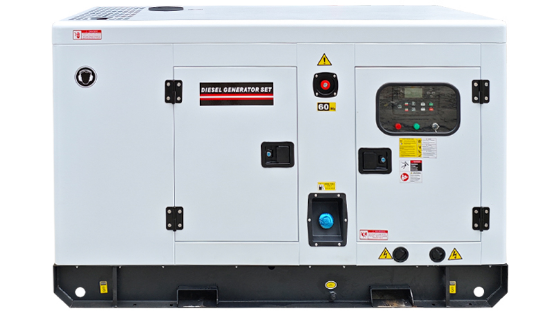
Telecom's most profitable coverage gaps are often at altitude — mountain passes, highland towns, ridge-top relays. Atmospheric density falls roughly 1% for every 100 m above about 1,000 m, and both engine output and alternator cooling degrade with it; high ambient temperatures compound the derating. Specify turbocharged, intercooled engines rated for the actual site altitude and request the manufacturer's derating tables. Longhong's experience delivering a Weichai-powered generator to a mining operation at 5,300 m altitude shows what properly derated, high-altitude configuration looks like in practice — the same engineering discipline applies to mountain-top base stations.
Tower sites are increasingly unmanned. A generator that needs someone to drive out and start it is a generator that fails its purpose — the control system must do everything on its own and report everything to the network operations center.
An automatic mains failure (AMF) controller monitors the grid, starts the engine when voltage drifts out of tolerance, stabilizes output and signals the contactor or transfer switch — typically restoring site power within 10–15 seconds, well before the battery bank reaches its discharge floor. When mains returns, the controller transfers the load back, runs a cooling-down period and shuts down. Factory-integrated packages such as the 64 kW automatic diesel generator — a true auto-start diesel generator with matched control and transfer hardware — remove the integration risk of mixing controller brands, which matters when a fault at a remote site can take days to reach.
Modern controllers speak the languages a network operations center already uses — Modbus, SNMP and GSM/GPRS reporting — streaming fuel level, coolant temperature, battery voltage, run hours, load percentage and fault codes alongside the site's own alarms. This is what makes preventive dispatch possible: refuel the sites running low on a scheduled loop, service the units approaching hour thresholds, and investigate a generator that repeatedly fails to start before it takes the site dark. For portfolios of hundreds of towers, telemetry is not an optional extra; it is how operating cost is controlled.
Hybrid sites pair photovoltaic arrays and lithium storage with a compact diesel genset: the batteries carry the daily load, the PV recharges them, and the generator covers prolonged cloudy periods and recharges the bank when state of charge falls below a floor. The sizing logic inverts — the genset is matched to average load, not the peak, because the battery absorbs transients — and the controller must coordinate sources so the engine never idles at low load for long, where unburned fuel causes wet stacking. Done well, hybrid configuration cuts fuel consumption at an off-grid site by 50–70% while keeping the diesel genset as the firm capacity guarantee.
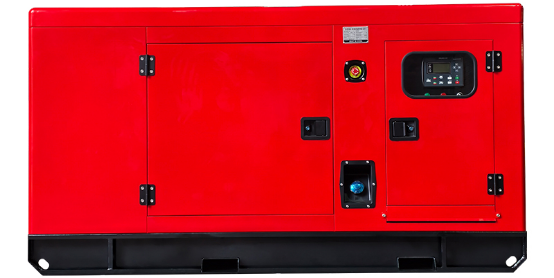
The enclosure decision on a tower site is driven by neighbors, climate and security — in that order.
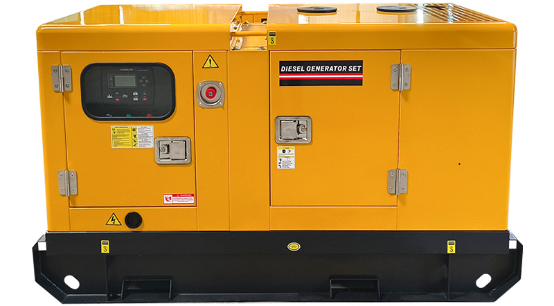
Towers stand next to homes, schools and clinics far more often than buyers expect, and a site that runs nightly in weak-grid areas needs a proper canopy diesel generator holding noise near 65–75 dB(A) at 7 meters. Residential-adjacent sites justify a super-silent canopy with additional attenuation; rooftop sites favor the smallest canopy that carries the load, both for structural loading and for crane access. Because telecom gensets run frequently rather than occasionally, also verify the canopy's cooling capacity at continuous duty — an enclosure quiet but starved of airflow will derate the set exactly when the site needs full output.
For desert, coastal, high-security and high-altitude sites, the containerized diesel generator is the standard answer: genset, fuel system, controls and ventilation factory-integrated into an ISO container with weatherproofing, anti-corrosion coating for salt air, anti-vandal locks and room for extended fuel storage. Multiple containers can be paralleled into a small diesel power plant where a regional hub or co-location campus outgrows a single machine. Hub sites and switching centers in this class typically start at the 100 kW silent generator rating and scale upward.
Network rollout creates its own power demand: cell-on-wheels deployments after disasters, temporary coverage for festivals and construction camps, commissioning power for new sites before the grid connection lands. A mobile trailer diesel generator moves between these jobs and doubles as permanent standby equipment when a site becomes fixed; a standard construction site diesel generator set serves the same rollout crews building the tower infrastructure itself. For short commissioning work on microwave relays and small cabinets, a portable diesel generator in the smallest canopy sizes covers the task — the same principle behind an engineering emergency diesel generator set staged for project emergencies.
On remote sites, fuel logistics decide reliability as much as the engine does. The best generator in the world stops when its tank runs dry on a road washed out by rain.
Work the arithmetic honestly. A 32 kW set at 60% average load consumes roughly 6–7 litres per hour, so 48 hours of autonomy needs about 350 litres — within reach of an oversized base tank — while 72 hours or a weekly refueling loop needs external storage of 500–1,000 litres with automatic transfer. Match autonomy to the real refueling cycle of your logistics contract, not to an optimistic assumption, and include low-level telemetry alarms with enough lead time for the truck to arrive. Off-grid and hybrid sites that run daily should model consumption per kilowatt-hour delivered, because that number drives the site's entire operating cost.
Remote diesel is frequently stored long, transported in dirty containers and exposed to temperature swings that condense water into the tank. Specify water separators, biocide dosing in humid climates, and periodic fuel polishing for bulk storage; a clogged filter at a mountaintop site is a site outage. Longhong's export projects — such as a 100 KVA Cummins generator delivered to Tanzania for off-grid East African duty — are configured with exactly these field realities in mind: large tanks, simple serviceability and engines with regional parts availability.
China produces more diesel generator set equipment than any other country, and for tower fleets ordered in dozens or hundreds of units, the right diesel generator factory delivers both unit economics and configuration flexibility that generic trading companies cannot match.
State the duty explicitly: standby or prime, average and peak site loads including the battery recharge increment, voltage and frequency, site altitude and ambient temperature, enclosure class and noise limit, fuel autonomy target, and the controller's required protocols for your NMS integration. Insist on genuine, nameplate-verifiable engines — Longhong builds with Cummins, Weichai, Yuchai, Perkins, Volvo and Yunnei engines matched to copper-wound alternators — and require the alternator brand and winding data in writing. A credible diesel generator supplier returns a sizing calculation that shows recharge-peak acceptance, not just a price list; that document is the single best filter for supplier quality.
Require a factory acceptance test on your specific units — rated-load run, 110% overload check, voltage and frequency regulation, ATS function test — documented with video or third-party inspection, and verify CE and ISO certification on the manufacturer's qualifications page. For fleet orders, ask about permanent stock: Longhong holds over 200 units in permanent stock, which converts a 60-day procurement cycle into days when a rollout schedule or disaster recovery demand moves up. Whether your fleet needs a UK diesel genset configured at 230/400 V, 50 Hz for European-standard networks or a "generator electrico" for Latin American operators, the factory should confirm the exact voltage, frequency and socket configuration before production.
Canopy sets ship efficiently in standard containers; containerized sets are inherently container-native. Confirm lifting points, base-frame tank capacity, tropicalization for humid climates, and the warranty's coverage of both engine and alternator with spare parts availability stated in writing. Longhong has exported to Cambodia, Vietnam, Myanmar, Tanzania, Libya and other markets, and supports commissioning guidance and staff training remotely — because the first grid failure at a newly commissioned site is the wrong moment to discover no one on the ground knows the AMF sequence. The same procurement discipline applies whether you are buying tower sets or a general power outage backup power generator for a corporate campus: specify, test, verify, then scale.
Telecom site power rewards buyers who respect the load profile. Size for the battery recharge peak, not the average; rate the engine for the duty the site actually cycles; insist on AMF control and telemetry that integrate with your network management system; choose the enclosure for the site's neighbors and climate; and plan fuel around the real logistics of the region. Then source from a China diesel generator manufacturer who proves genuine engines, documents factory tests and holds stock. Do that, and every tower in the portfolio stays on air through whatever the grid does. For a sizing review or a fleet quotation on auto-start diesel generator packages from 3 kVA to 3,000 kVA, contact Longhong Power — our engineers respond with calculations, not catalogs.


