

 English
 العربية
 Español
 Русский
Industry News
Industry News

High-rise buildings are among the most power-sensitive assets in any modern city. A single utility failure can trap people in elevators, silence fire pumps, stop smoke-control fans, darken emergency lighting circuits, and cost building operators and tenants a fortune in lost productivity. Because the consequences move far beyond inconvenience, the standby diesel generator in a tower is not merely an accessory — it is a life-safety system that must be engineered into the building from the earliest design stage. This guide is written for developers, facility managers, MEP consultants, and procurement teams who need to buy a diesel generator set for a high-rise project in 2026. It explains the unique constraints of vertical buildings, compares rooftop and basement placement, shows how to size for elevator and fire-pump inrush, discusses noise and vibration control, and outlines what to look for when sourcing from a China diesel generator manufacturer.
Unlike a single-storey warehouse or a suburban home, a high-rise cannot simply wait for the grid to return. Gravity, fire safety, and occupancy density make uninterrupted power a non-negotiable requirement. Life-safety loads — fire pumps, smoke-extraction fans, emergency elevators, public-address systems, and exit lighting — must come online within seconds of a mains failure. Critical loads such as server rooms, medical refrigerators, security control centers, and building-management computers must stay up long enough for an orderly shutdown or continuous operation. Even non-essential loads like tenant air-conditioning become serious comfort and liability issues during an extended outage in a sealed glass tower.
Urban grids are also more vulnerable than their rural counterparts to cascading faults, cable excavation damage, transformer overloads, and extreme weather. A power outage backup power generator sized and installed correctly turns a building from a passive victim of grid events into a resilient facility that protects occupants and operations. For buyers, this means the genset must be treated as part of the building's structural and safety systems, not as a last-minute procurement item. Start by reviewing the full range of diesel generator products to understand which ratings and enclosures match high-rise constraints before committing to a layout.
The first strategic decision is where the machine will live. Rooftop placement frees valuable basement and podium space, keeps the set above flood level, and shortens exhaust routing, but it introduces serious structural and logistics questions. A 500 kVA canopy diesel generator with fuel can weigh more than six tonnes, and the dynamic loads during startup and running are higher than the static weight suggests. Before selecting a rooftop location, a structural engineer must confirm that the slab, columns, and vibration transmission paths can handle the load without distressing the building frame or disturbing tenants below.
Delivery is the next challenge. A crane lift to a high rooftop is expensive, weather-dependent, and sometimes impossible in dense downtown districts. Some projects use a mobile crane from an adjacent street; others require a tower crane during construction and then reserve a permanent maintenance path. Basement and podium-level plant rooms avoid the crane problem, allow easier service access in bad weather, and keep noise away from neighbors, but they require robust ventilation, flood protection, and a fuel delivery route that can handle tanker access.
Both rooftop and basement sets need enormous volumes of combustion and cooling air. On a roof, wind direction matters: the cooling air intake must not sit downwind of the exhaust outlet, or hot recirculated air will raise intake temperatures and derate the engine. In a basement, intake louvers, ducting, and extractor fans must be sized for the worst summer afternoon plus altitude and filter losses. Exhaust pipes must be routed away from air-handling intakes, operable windows, and pedestrian plazas. A rooftop discharge point high above the parapet is usually the simplest way to meet city environmental codes; basement installations may need tall exhaust stacks that run up the building facade.
Basements and podium plant rooms are attractive for security and service access, but they are the first places to flood during a storm or water-main break. Any emergency diesel generator installed below grade must sit on a raised housekeeping pad, with sump pumps and fuel-containment systems that keep water out of the day tank and electrical panels. Fuel deliveries also become more complicated in basements: tankers may not be able to reach the fill point, so fuel may need to be transferred from an above-ground bulk tank through a dedicated pump set. Rooftop installations avoid flooding but limit the size of on-board fuel tanks and often require fuel to be pumped upward, adding cost and complexity.
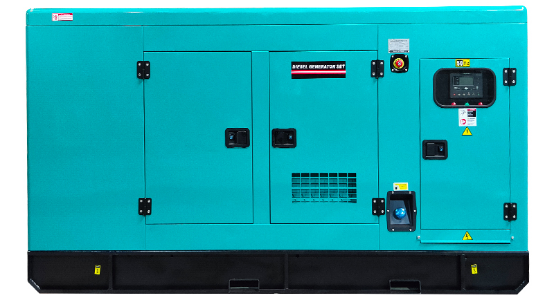
Correct sizing begins with classifying every load the generator must carry. Life-safety loads have the highest priority and usually determine the minimum engine rating because they include large motors with high starting currents. Critical loads such as data centers, medical equipment, and security systems come next. Essential loads — basic lighting, communication rooms, and some ventilation — are third. Non-essential loads such as decorative lighting, general tenant sockets, and discretionary HVAC are normally shed during an outage. A clear load-shedding strategy prevents an oversized and overpriced diesel power generator while still protecting the building.
| Load category | Examples | Priority during outage |
|---|---|---|
| Life safety | Fire pumps, smoke fans, emergency elevators, exit lighting | Must run |
| Critical | Server rooms, medical gear, security, BMS | Must run |
| Essential | Basic lighting, communication, limited HVAC | Run if capacity allows |
| Non-essential | Decorative lighting, tenant sockets, full HVAC | Shed |
The biggest sizing trap in high-rise projects is ignoring motor starting. Fire pumps and emergency elevators often start direct-on-line, drawing five to seven times their running current for a few seconds. If the generator is only sized for steady-state load, the voltage dip during motor starting can drop below the threshold that keeps contactors, variable-speed drives, and electronic controls alive. Good practice is to keep transient voltage dip within 15–20% and to specify alternators with heavier windings and closer voltage regulation. Where possible, sequence the start of large motors so they do not all start at once, and use soft starters or variable-frequency drives on non-essential motors to reduce inrush.
Consider a 30-storey tower with retail on the lower floors and offices above. After applying diversity factors, the continuous emergency load is 160 kW. Add a 75 kW fire pump and a 45 kW smoke-extraction fan, both direct-on-line. The total steady load is 280 kW, but the starting kVA requirement pushes the selection toward a 350–400 kVA class machine. At sea level and 30 °C ambient, a 100kW diesel generator serves smaller towers or partial loads, while larger complexes move into the 300–500 kVA range. For a compact footprint and lower noise, an 80kW silent diesel generator is often specified for podium plants serving residential or hotel towers up to about 25 storeys.
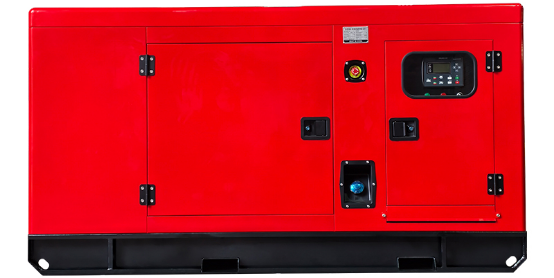
High-rise buildings sit close to neighbors, offices, hotels, and apartments. A standard open-frame diesel genset can produce 95–105 dB(A) at one meter, which is unacceptable in almost any urban setting. City codes typically limit daytime noise at the property line to 55–65 dB(A) and nighttime noise to 45–55 dB(A). A canopy diesel generator with properly designed air-inlet and exhaust silencers can reduce this to 65–75 dB(A) at one meter, and with good placement and acoustic screening can meet most city limits. Where codes are stricter — for example, near hospitals or schools — a super-silent containerized or custom acoustic enclosure may be required.
Diesel engines produce low-frequency vibration that travels through building structure long after airborne noise has been absorbed. In a tower, this can disturb tenants many floors away. Anti-vibration mounts under the engine-alternator package, flexible exhaust bellows, and flexible fuel and electrical connections are essential. For rooftop installations, inertia bases and spring isolators may be needed to prevent vibration from entering the slab. In basement plant rooms, floating slabs and isolation joints around pipe penetrations keep structure-borne noise from propagating through columns and walls. A well-specified 32kW silent diesel generator for smaller high-rise auxiliary loads includes factory-mounted anti-vibration pads and close-coupled silencers that reduce site installation work.
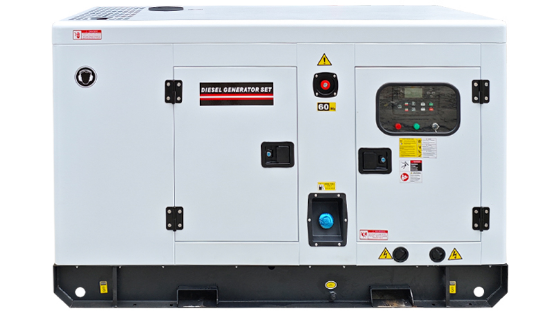
Fuel storage in a high-rise is always a compromise between runtime autonomy and fire-safety regulations. Base-frame tanks built into the genset typically provide 8–12 hours of runtime, enough for short outages and orderly shutdowns but not for multi-day grid failures. A separate day tank sized for 24 hours, fed from a larger bulk tank or from fuel deliveries, is the most common arrangement. In podium or basement plant rooms, a double-walled bulk tank with a containment bund is usually the safest approach. On rooftops, fuel is usually limited to the built-in tank or a small day tank because of weight and code restrictions, with refueling via a dedicated pump from a ground-level bulk tank.
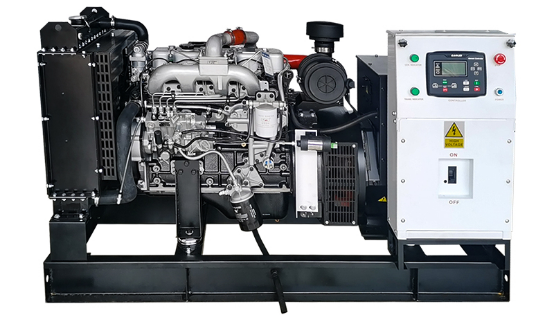
Standby diesel degrades over time. Water condensation, microbial growth, and particulate contamination are the main enemies of a reliable emergency diesel generator. High-rise installations should include water separators, fine filtration, and either a fuel-polishing circuit or a scheduled polishing service. Local fire codes will dictate tank capacity limits, venting, leak detection, and separation from building occupancy; these rules must be checked before the plant room layout is finalized. A plant room designed around an open-frame diesel generator will generally have simpler fuel connections than a containerized set, but it needs more acoustic and ventilation engineering to compensate.
A manual-start generator is not acceptable for a high-rise. The standard architecture is an auto-start diesel generator with an automatic transfer switch that senses mains failure, starts the engine, confirms voltage and frequency, and transfers the load — typically within ten seconds. For life-safety loads such as fire pumps and smoke fans, some jurisdictions require transfer within the same ten-second window, which means the AMF controller, starter battery, fuel system, and heater must all be maintained in a constant state of readiness. Battery chargers, coolant heaters in cold climates, and regular exerciser cycles are therefore mandatory, not optional.
Modern high-rise buildings already have a building-management system that monitors HVAC, power, fire alarms, and access control. Integrating the genset into this ecosystem gives facility teams real-time visibility of fuel level, battery voltage, coolant temperature, oil pressure, run hours, and fault alarms. Remote monitoring via GSM or Ethernet also allows the generator supplier to diagnose alarms before a service truck is dispatched, reducing downtime. A 64kW auto-start diesel generator with a digital AMF controller is a practical example of a factory-integrated package that simplifies BMS handshaking and remote telemetry.
China is one of the world's largest sources of diesel power plant equipment, and experienced buyers know that quality varies widely. For a high-rise project, the supplier must do more than ship a machine: it must provide certified engines and alternators, factory acceptance testing, detailed installation drawings, and after-sales parts support. Start by verifying the company profile and certifications. Guangdong Longhong Electromechanical Equipment Co., Ltd. has been building generators since 2010 and offers CE and ISO-certified products ranging from 3 kVA to 3,000 kVA, using Cummins, Weichai, Yuchai, Perkins, Volvo, and Yunnei engines.
Check the qualifications and certifications page to confirm compliance documents before issuing a purchase order. Ask for a factory acceptance test report with load-bank results, witness the test remotely if travel is difficult, and request packaging suitable for the delivery route — whether that is a crane lift to a rooftop or a basement haul through a loading dock. With more than 200 units in permanent stock and export experience to Cambodia, Vietnam, Myanmar, Tanzania, Libya, and other markets, Longhong can configure voltage, frequency, and enclosure options to match local codes. For a real-world reference, a school 500KVA silent generator installation shows how a large canopy set can be integrated into a busy site with strict safety and noise requirements.
Buying a diesel generator set for a high-rise building means solving vertical, structural, acoustic, and fuel-handling problems that do not exist in low-rise projects. The right machine is the one that fits the building, not just the load list. Start by choosing between rooftop and basement placement based on structural capacity, flood risk, crane access, and fuel logistics. Size the unit for motor-starting inrush and life-safety transfer times, not just steady-state kW. Specify a canopy diesel generator or containerized package that meets city noise limits, and engineer vibration isolation from the start. Plan fuel storage for the required autonomy, and insist on fuel polishing and water separation. Finally, integrate auto-start, ATS, and remote monitoring so the facility team knows the set is ready before the grid ever fails. With these decisions made early, the tower will have a resilient standby diesel generator that protects both people and property for decades.


