

 English
 العربية
 Español
 Русский
Industry News
Industry News

When the grid fails at a shopping mall, the loss is money. When the grid fails at a water treatment plant or a sewage pumping station, the loss is service: raw sewage can overflow within hours, treated water pressure collapses, and communities lose safe supply until power returns. That is why water authorities, municipal utilities and EPC contractors treat the diesel generator set as process equipment, not an accessory. This guide walks through what makes pumping loads different from ordinary building loads, how to size a genset for pump motors that start hard, which enclosures and controls suit outdoor plant environments, and what to demand when buying from a China factory. Guangdong Longhong Electromechanical Equipment Co., Ltd., a China diesel generator manufacturer established in 2010 with over 20 years of team experience, supplies 3–3,000 kVA units with Cummins, Weichai, Yuchai, Perkins, Volvo and Yunnei engines, CE and ISO certification, and 200+ sets in permanent stock.
Water and wastewater systems are continuous-process infrastructure. Each link in the chain — intake screens, chemical dosing, filtration, disinfection, high-lift pumps, and in the wastewater direction, lift stations and aeration blowers — depends on motors that stop the moment electricity stops.
At a treatment plant, a stopped train of equipment can mean discharge permit violations and public-health exposure; at a deep lift station, it can mean sewage surcharge into streets within a few hours of heavy rain. Water utilities therefore plan for an emergency diesel generator that starts automatically and carries the full process, not just the control room. Outage duration assumptions matter too: in many export markets Longhong serves — from Southeast Asia to Africa — daily load-shedding and weak rural grids mean the genset may run four to ten hours a day as a prime power generator, not an occasional backup. Classifying your real duty (standby versus daily running) before you request quotations is the single step that most improves the accuracy of factory pricing.
Municipal specifications typically require documented standby capacity for critical stations, sometimes with N+1 redundancy and mandated monthly test runs under load. Buyers should also note that water-sector generators often run long, steady sessions after storms — exactly the pattern where an undersized or poorly maintained unit fails. A properly specified industrial emergency diesel generator with generous cooling margin and a real load-test regime will outlast several budget units that looked identical on a bid tabulation sheet.
Water facilities are motor-dominated loads, and that shapes every downstream decision about the genset.
A centrifugal pump's running current is modest, but its starting current is not. Direct-on-line (DOL) starting draws six to eight times the motor's rated current and demands roughly two to three times its rated kVA from the supply for a second or two. A star-delta or soft starter cuts that peak; a variable frequency drive (VFD) can hold starting demand near running levels, but VFDs introduce harmonics that the genset's alternator must tolerate. When you size a three-phase diesel generator for a pump station, the largest motor's starting method — not the running load — usually decides the alternator's transient performance and the engine block's ability to recover from the sudden block load.
A competent design does not start every pump simultaneously on generator power. Modern AMF controllers can stage loads: blowers first, then dosing systems, then large pumps in sequence with a few seconds between steps. Load-sequencing reduces the required genset rating by 20–40% compared with worst-case simultaneous starting, which directly lowers purchase price, fuel consumption and installation footprint. Ask your supplier to confirm the controller supports staged starting before you finalize a specification — every auto-start diesel generator in Longhong's range, from the compact 32kW silent generator upward, can be fitted with staged-load control for exactly this purpose.
Consider a small-town sewage pumping station: two 15 kW submersible pumps (duty/standby), a 3 kW mixer, dosing pumps and controls totalling 4 kW, plus 2 kW of lighting and telemetry. Running load ≈ 24 kW if everything runs together; realistic diversity brings it to about 20 kW. The largest motor starts DOL, adding roughly 45 kVA of transient demand.
Rule of thumb: genset standby rating ≈ running load plus starting allowance, sized so voltage dip at motor start stays within the controller's ride-through (commonly under 15–20%). For this station, a 40–50 kW class set covers the DOL start with margin; converting the pump to a soft starter could pull the requirement down toward 30 kW. For a village water scheme with daily running instead, the same arithmetic is expressed in prime rating with the 70% average-load rule in mind. Buyers comparing frames will find the 40kW export diesel generator and the 64kW automatic generator sit exactly in this pumping-station class, while larger treatment plants typically parallel multiple 80–100 kW frames or step up to a single 400KW/500KVA Yuchai silent generator installation.
Pump stations in highland districts and tropical climates must account for derating: output falls roughly 1% for every 100 m above 1,000 m and around 2–3% for every 10 °C above 40 °C ambient. Longhong's export record includes sets proven at extreme altitude — the Weichai generator operating at 5,300 m in a high-altitude mining area — and the same derating discipline applies to mountain water schemes. State your altitude and ambient temperature in the enquiry and let the factory confirm the corrected rating in writing.
Most water assets sit outdoors, often in humid, corrosive or flood-prone locations, and frequently near residential areas whose tolerance for noise is limited.
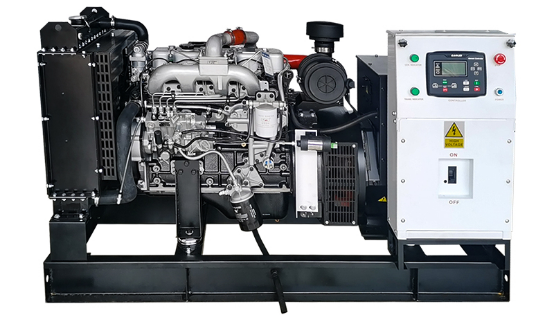
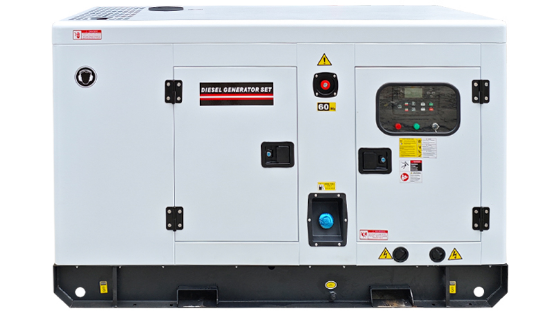
A weatherproof canopy diesel generator is the default choice for pump stations: it protects the set from rain and dust, holds noise near 65–75 dB(A) at 7 m for neighbor-friendly operation, and allows skid mounting above flood datum. Larger plants with multiple units, switchgear and fuel storage step up to containerized diesel generator solutions, which provide walk-in service access and house the entire power room in one certified box. Open frames remain appropriate inside dedicated plant rooms with ventilation engineered in — they are cheaper and easier to service, and a diesel power plant room at a treatment works usually already has the airflow budget to house one. Mobile units — a mobile trailer diesel generator or trailer type construction site generator format — suit utilities that rotate one rental-grade set across several small stations during maintenance windows or emergencies.
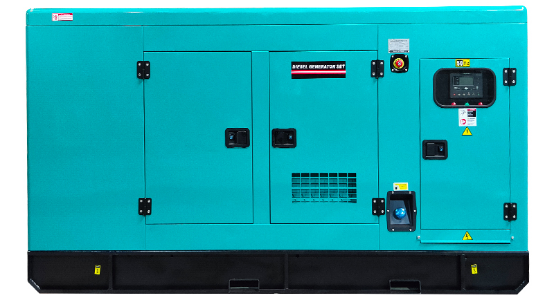
Wastewater environments carry hydrogen sulfide and humidity that corrode ordinary steelwork. Buyers should request canopy protection class (IP23 or better), tropicalized radiators, anti-corrosion coating on the base frame, and block heaters for reliable starting in cold districts. These options are standard practice for an experienced source factory and add little cost — but only if they appear in the purchase contract rather than an oral promise.
Two control decisions define whether a water-sector genset actually protects the process: how fast it takes over, and how long it can run.
An automatic mains failure (AMF) controller watches the utility supply, starts the engine within seconds of a blackout, and closes the ATS once voltage and frequency are stable — total transfer commonly inside 10–15 seconds, fast enough that SCADA systems and dosing controls ride through. For unmanned stations, add remote monitoring (GSM/4G telemetry reporting fuel level, battery voltage, running hours and alarms), so the utility knows a station is running on diesel before residents call. Longhong's 80kW silent diesel generator and larger frames are routinely configured with AMF panels and telemetry for exactly this unattended-duty profile.
Fuel consumption scales with load: as a planning figure, a 100 kW class set burns roughly 20–25 liters per hour at 75% load, so a base-tank day tank gives only 8–12 hours. Storm-driven outages routinely exceed that. Design for the realistic outage duration in your region — 24, 48 or 72 hours — with an external bulk tank, and standardize on one fuel spec across the fleet so emergency deliveries are simple. Water authorities in markets with weak grids often combine bulk storage with a prime-rated set; the 100KVA Cummins generator exported to Tanzania illustrates the daily-running configuration many utilities actually need.
China offers the strongest price-performance in the genset market, and water utilities from Southeast Asia to Africa are among its most experienced repeat buyers. A disciplined enquiry converts that price advantage into a reliable asset.
Five facts let a factory quote accurately in one reply: the load list in kW with the largest motor and its starting method; expected running hours per day and year (this sets standby versus prime rating); site altitude and ambient temperature; electrical format — municipal equipment almost always needs a three-phase diesel generator at 380/400V 50Hz or 220/480V 60Hz; and enclosure preference. Buyers procuring in Spanish often search "generator electrico" or "UK diesel genset" style configurations — the underlying spec sheet is identical. Then ask for: engine and alternator brand confirmations in writing, a factory acceptance test report including the motor-start voltage-dip figure, and the CE and ISO certification documents for the complete set.
Three questions reveal whether you are dealing with a genuine source factory. First: "What voltage dip does this alternator produce starting my largest motor DOL?" — a real manufacturer answers from alternator transient curves, not guesses. Second: "Which controller model, and does it support staged load starting and remote telemetry?" Third: "What is in permanent stock, and what is the lead time?" Longhong keeps 200+ units in permanent stock and has exported to Cambodia, Vietnam, Myanmar, Tanzania, Libya and beyond since its founding — the company profile and full diesel generator product catalog let buyers verify the range from 3 kVA compact sets up to megawatt-class installations before the first email is even sent. For smaller facilities — a single booster station or a rural clinic water point — the same factory discipline scales down to a generator for home-class 10–24 kW set without changing the sourcing logic.
Water and wastewater infrastructure asks more of a diesel genset than almost any commercial building: hard-starting motors around the clock, corrosive outdoor air, unattended operation and outage durations measured in days. The winning specification formula is consistent — classify your duty honestly, size around motor starting rather than running load, stage the loads, enclose for the environment, automate the start, and plan fuel for the worst storm you have actually experienced. Do that, and a single well-chosen set will protect service for decades. When you are ready to specify, Guangdong Longhong Electromechanical Equipment Co., Ltd. will review your pump schedule, confirm the corrected rating for your altitude and climate, and quote standby and prime figures for the same frame — backed by factory test reports and certifications you can hand directly to your project engineer.


