


 English
 العربية
 Español
 Русский

Home Diesel Generators: 2026 Buyer's Guide to Residential Backup Power
By Guangdong Longhong Electromechanical Equipment Co., Ltd. | October 17, 2026
A power outage backup power generator is no longer a luxury for large estates. Homeowners, small farms, remote cabins, and suburban families are turning to the diesel generator set because it delivers longer runtime, safer fuel storage, and lower lifetime cost than most gasoline alternatives. If you are researching a generator for home use in 2026, this guide explains how to size, install, and source a reliable home diesel generator without overpaying for capacity you will never use.
Guangdong Longhong Electromechanical Equipment Co., Ltd. has been a China diesel generator manufacturer since 2010. Our catalog covers open-frame, canopy diesel generator, trailer, and containerized units from 3 kVA to 3,000 kVA. In this article, we focus on residential projects where noise, auto-start, and fuel autonomy matter most.
Why Homeowners Choose Diesel for Backup Power
Gasoline portable units dominate the weekend-camping market, but a residential standby diesel generator wins on three points that matter for a house: runtime, safety, and engine life.
Longer Runtime on a Single Tank
Diesel fuel contains roughly 15% more energy per litre than gasoline. A 20 kW diesel genset running at 75% load consumes about 4.5–5.5 litres per hour, while a gasoline unit of similar rating burns 6.5–8 litres per hour. For a home expecting a 24-hour outage, that difference can mean the tank size drops from 200 litres to 130 litres, saving yard space and fuel cost.
Safer Fuel Storage at Home
Diesel has a higher flash point than gasoline and does not vaporise easily. Stored in a vented, bunded tank, it is far less likely to ignite from a stray spark. Many home insurance policies treat a properly installed diesel tank more favourably than a gasoline container.
Engine Longevity and Less Maintenance
Diesel engines operate at lower RPM and rely on compression ignition, reducing wear on spark plugs and ignition components. A well-maintained diesel power generator for home use can reach 10,000–15,000 running hours before a major overhaul, compared with 2,000–4,000 hours for a typical gasoline engine. That matters when the unit may only run during emergencies but must start reliably after months of standby.
For families who want a permanent solution rather than a wheeled emergency unit, a Longhong Power silent diesel generator offers the durability of an industrial engine inside a weatherproof canopy quiet enough for a suburban garden.
Sizing a Home Diesel Generator
The most common mistake when buying a generator for home is guessing the kilowatt rating. Oversizing wastes capital and causes "wet stacking" (unburned fuel residue) from running too lightly loaded. Undersizing leads to overload trips every time the water heater or air conditioner starts.
Whole-House vs Partial-Load Backup
A whole-house diesel generator must cover everything that could run at once: lights, refrigerator, water pump, HVAC, cooker, and laundry. A partial-load or essential-circuit design powers only critical items through a separate emergency distribution panel. Partial-load designs are smaller, quieter, and cheaper, but require a transfer switch with load shedding.
How to Calculate Home Load
Start with a running-watts list. Add the continuous loads you cannot turn off—refrigerator, freezer, router, security system, sump pump—and then add the largest motor-starting surge, typically an air conditioner or well pump. Motor starting can demand 3–7 times the running current for a few seconds. A safe rule is to size the diesel generator set to at least 1.25 times the total running watts plus the largest surge.
| Home Type | Typical Continuous Load | Recommended Rating |
|---|---|---|
| Small apartment / cabin | 4–8 kW | 10–14 kW |
| 3–4 bedroom suburban home | 10–18 kW | 20–24 kW |
| Large home with pool / workshop | 18–30 kW | 30–40 kW |
| Estate / multi-building compound | 30–60 kW | 60–100 kW |
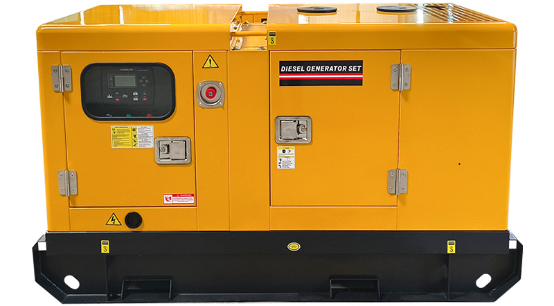
For a small suburban home, the 10–14 kW silent generator is an excellent starting point. A typical 3-bedroom house with gas heating and a well pump will usually fit comfortably within a 20 kW silent diesel generator. Larger homes with electric HVAC and workshops should look at the 32 kW silent diesel generator.
Single-Phase vs Three-Phase for Houses
Most houses in North America and many other regions run on single-phase diesel generator output: one live, one neutral, and one earth. In Europe, Asia, and parts of Africa, a typical home may be supplied with 230 V single-phase or 400 V three-phase, depending on the utility.
When Single-Phase Is Enough
For loads up to about 24 kW, a single-phase diesel generator is usually simpler and cheaper. It matches standard household outlets, lighting circuits, and single-phase pumps. A 20 kW or 24 kW silent diesel generator from Longhong Power can be configured in single-phase output for direct connection to a home transfer switch.
When Three-Phase Makes Sense
A three-phase diesel generator is worth considering if the property has a large workshop with three-phase machinery, an elevator, a swimming-pool heat pump, or plans to feed multiple buildings. A 32 kW or larger set can deliver balanced three-phase power and single-phase taps through a distribution board. The important point is to confirm with your electrician whether your incoming supply is single-phase or three-phase before ordering.
Longhong Power alternators are wound with 12 reconnectable leads, so the same diesel genset can often be configured for 220/380 V 50 Hz or 120/208 V 60 Hz at the factory. This flexibility is especially useful for international buyers who need a UK diesel genset or a North American residential configuration.
Noise, Enclosure, and Placement
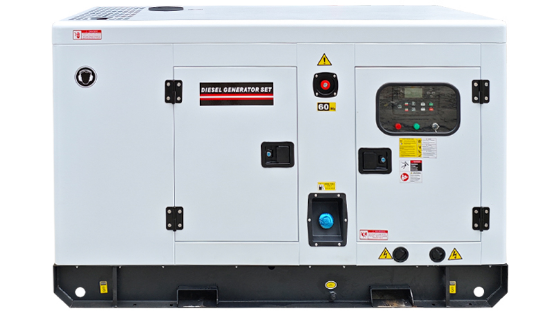
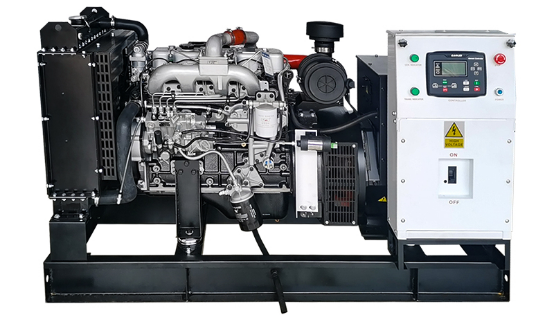
Noise is the biggest reason a residential generator project fails council approval or sparks neighbour complaints. An open-frame portable diesel generator can produce 95–105 dB(A) at 1 metre—roughly the volume of a motorcycle. A properly built canopy diesel generator can reduce that to 65–75 dB(A) at 7 metres, comparable to normal conversation or a dishwasher.
Understanding the dB(A) Numbers
Manufacturers usually quote noise at 7 metres in free field conditions. Every doubling of distance drops the level by roughly 6 dB(A). So a set rated at 70 dB(A) at 7 metres becomes about 64 dB(A) at 14 metres and 58 dB(A) at 28 metres. Check your local by-law limit; many residential areas enforce 55–65 dB(A) at the property boundary during daytime, and lower limits at night.
Canopy Construction That Actually Works
A genuine residential-grade canopy has five layers of noise control: perforated steel inner skin, rock-wool or foam sound absorption, a solid outer skin, baffled air intake and exhaust, and anti-vibration mounts between the engine and the frame. Cheaper enclosures bolt sheet metal directly to the engine base and call it "silent"; they often provide only 3–5 dB reduction.
Placement Tactics
Place the unit as far as practical from bedroom windows and the neighbour's boundary. Point the exhaust away from houses, use a solid fence or masonry wall as a noise barrier (leave airflow gaps), and install the generator on a concrete pad with anti-vibration pads. Never place a diesel generator inside a garage or enclosed porch without engineered ventilation; exhaust carbon monoxide is lethal.
Auto-Start, ATS, and Fuel Storage
A portable unit with a pull start is fine for occasional camping, but a permanent home backup system should start automatically when the grid fails. That is where the auto-start diesel generator and automatic transfer switch (ATS) come in.
How Auto-Start Works
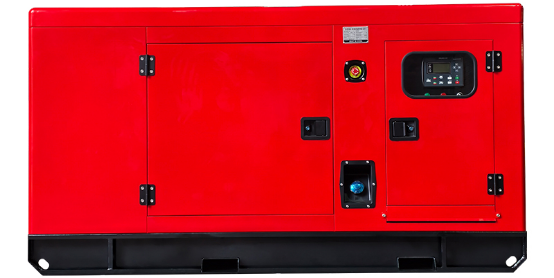
The controller monitors the mains voltage. When it detects an outage, it waits a short delay (to avoid nuisance starts during brief flickers), cranks the engine, waits for stable voltage and frequency, and then signals the ATS to transfer the house load. When mains returns, the ATS switches back to utility and the engine runs a cool-down period before shutting down. Longhong Power 64 kW automatic generator controllers include Deep Sea or Smartgen modules with programmable exercise schedules.
ATS Sizing and Safety
The ATS must be rated for the generator's full output current and must have a mechanical interlock that prevents the generator and grid from feeding the house at the same time. For whole-house backup, a 2-pole or 4-pole ATS is installed between the meter and the main distribution board. For partial-load backup, a smaller ATS or a contactor-based load-shed panel is used.
Fuel Tank and Autonomy
Residential diesel tanks are typically 100–500 litres for single-family homes and 500–1,000 litres for estates. At 75% load, a 24 kW diesel genset burns roughly 5 litres per hour, so a 250-litre tank gives about 50 hours of runtime. If your area experiences multi-day outages, size the tank for at least 72 hours of continuous operation or arrange a refueling contract.
Additives and water separators matter. Diesel can grow algae in hot climates and gel in cold climates. A polishing filter, water separator, and biocide treatment protect both the engine and the home's fuel investment.
Buying from China: Homeowner Checklist
Buying a home diesel generator directly from a China diesel generator manufacturer can cut 30–50% from the price of a comparable local brand, but only if the unit is correctly specified and tested before shipping. Use this checklist before placing an order.
- Confirm engine brand and origin. Ask for the Cummins, Perkins, Weichai, Yuchai, Volvo, or Yunnei engine serial-number range and a factory inspection certificate.
- Specify alternator type. A copper-wound brushless alternator with AVR is essential for stable voltage for electronics. Aluminium windings cost less but overheat faster.
- Request a factory acceptance test (FAT). The factory should run the set at 100% load for at least one hour, record voltage, frequency, oil pressure, and coolant temperature, and provide a test report.
- Match voltage and frequency to your country. 230/400 V 50 Hz for most of Europe, Asia, and Africa; 120/208 V 60 Hz for North America and parts of Latin America.
- Check noise data. Insist on a third-party noise report or a video measurement at 7 metres, not a marketing claim.
- Ask for canopy details. Sound-absorbing thickness, airflow path, exhaust silencer grade, and weatherproof door seals should be documented.
- Verify ATS compatibility. If you want automatic home backup, order the generator and ATS as a matched package from the same supplier to avoid controller communication issues.
- Review warranty and parts support. A residential generator should carry at least a 12-month or 1,000-hour warranty with clear spare-parts availability.
- Check certifications. CE marking for Europe, ISO 9001 for quality management, and any local grid-code approvals you may need.
- Clarify Incoterms and local support. Understand who handles shipping, customs, unloading, and commissioning. Some manufacturers, including Longhong Power, can recommend local electricians or agents in your region.
You can view our qualifications and certifications online, and our full diesel generator product catalog lists ratings from 10 kW to over 1,000 kW.
Conclusion
A home diesel generator is one of the few purchases that protects your family, your property value, and your comfort during a grid failure. The right size depends on whether you want whole-house coverage or essential-circuit backup, and on the largest motor-starting surge in your home. A silent diesel generator in a proper canopy, paired with an auto-start diesel generator controller and ATS, gives you true hands-off resilience.
When sourcing from China, do not choose on price alone. Verify the engine, alternator, noise test, FAT report, and warranty. Guangdong Longhong Electromechanical Equipment Co., Ltd. has supplied diesel generator sets to homes, farms, schools, hospitals, and industrial clients for more than 20 years. Browse our product pages or contact us to size a residential power outage backup power generator for your property.
About Guangdong Longhong Electromechanical Equipment Co., Ltd.
Founded in 2010 in Guangdong, China, Guangdong Longhong Electromechanical Equipment Co., Ltd. is a specialized China diesel generator manufacturer with more than 20 years of industry experience. We design and produce diesel generator sets from 3 kVA to 3,000 kVA, including open-frame, silent/canopy, trailer-mounted, and containerized models.
Our engines come from Cummins, Weichai, Yuchai, Perkins, Volvo, and Yunnei. All units are CE and ISO certified and supported by a permanent stock of more than 200 sets. We have exported to Cambodia, Vietnam, Myanmar, Tanzania, Libya, and many other markets. Learn more on our About Us page.


