English
 العربية
 Español
 Русский
Industry News
Industry News

A twenty-minute outage in a supermarket is not an inconvenience — it is a direct financial loss. Refrigerated and frozen display cases begin to drift above safe food temperatures within minutes, checkout systems and payment terminals go dark, and shoppers abandon full carts at the aisles. For a mid-sized grocery store, a single failed cold chain event can mean thousands of dollars in written-off stock, plus the reputational damage of food-safety complaints. This is why a correctly sized standby diesel generator has become standard equipment for modern supermarkets, convenience chains, and grocery distribution centers. As a China-based diesel generator manufacturer with more than 20 years of production experience, Longhong Power has supplied silent, canopy, and containerized gensets to retail and food-sector clients across Southeast Asia, Africa, and the Middle East. This guide walks you through every decision a grocery buyer should make before ordering.
Grocery retail sits in a unique position on the power-reliability spectrum. Unlike an office building, where an outage costs a few hours of productivity, a supermarket's core inventory is perishable. Industry food-safety rules in most countries require chilled products to stay below 4°C and frozen goods below −18°C; once display cases rise above these bands for more than a short window, retailers are legally obliged to discard the affected stock. A single power cut during a summer afternoon can wipe out an entire wall of dairy, chilled meat, and frozen desserts.
Three failure scenarios dominate supermarket loss reports:
Load-shedding schedules, storm damage, and transformer failures can interrupt supply for anywhere from 30 minutes to several hours. In many emerging markets where supermarket chains are expanding fastest, daily scheduled outages are still a normal part of operations, making a diesel power generator a permanent necessity rather than an emergency backup.
Summer heat waves push refrigeration compressors to maximum duty exactly when the grid is under heaviest load and most prone to voltage sags and brownouts. Low voltage is particularly dangerous for compressors: they draw higher current, overheat, and trip on thermal protection — sometimes repeatedly until the compressor fails outright.
Beyond written-off food, consider the hidden costs: lost transaction revenue during peak shopping hours, manual checkout chaos, freezer cleanup and restocking labor, and the knock-on effect of customers switching to a competitor whose lights stayed on. Against this backdrop, a properly specified diesel genset typically pays for itself after one or two avoided major outages.
The first mistake buyers make is sizing a generator from the building's total connected load. A supermarket's load is not uniform — it is layered, and each layer has different backup priority and different starting characteristics.
Refrigerated display cases, walk-in cold rooms, freezer islands, and compressor racks are the heart of the backup strategy. Compressors are motor loads with high inrush current: a direct-on-line (DOL) start can draw six to eight times the rated current. Modern stores using inverter-driven (VSD) compressors are far gentler on a genset, but older racks still dominate the sizing calculation. A medium supermarket's refrigeration plant alone commonly represents 30–50 kW of running load.
Checkout lanes, POS terminals, payment servers, barcode scanners, electronic shelf labels, security and CCTV systems, and emergency lighting all sit in Tier 2. These loads are small (often 5–15 kW) but extremely sensitive to voltage dips, so they should be fed through the genset's AVR-stabilized output or a small UPS buffer for seamless switchover.
Air conditioning, parking lot lighting, escalators, advertising screens, and non-essential plug loads can be shed or deferred during an outage. Load-shedding contactors that drop Tier 3 automatically allow a smaller genset to carry Tier 1 and 2 safely — a design trick that routinely saves buyers one full size class.
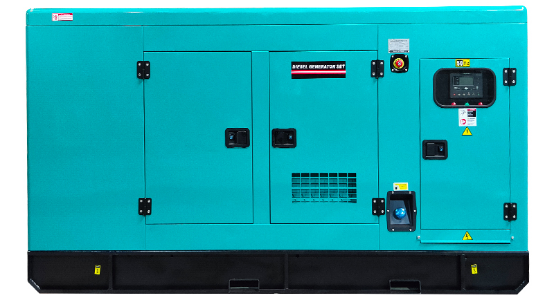
A 100kW silent generator set — a common class for mid-sized supermarket backup installations. See the 100kW diesel generator specifications.
Follow this four-step method used by our engineering team when quoting retail projects.
Walk the store with the facility manager and total the running watts of refrigeration racks, cold rooms, POS, lighting, and security. Exclude Tier 3 unless the store has no load-shedding capability.
Identify the largest compressor or motor started by the genset. For DOL starts, add a surge margin of roughly 2–2.5 times that motor's running rating to the total. Soft starters reduce this to about 1.5 times; VSD drives to about 1.2 times. If refrigeration is already inverter-driven, the genset can be sized almost purely on running load.
A diesel genset runs most efficiently and cleanly at 50–80% of its rating. Chronically light loading (below 30%) causes wet stacking and carbon buildup. Target a rating where your expected outage load sits at 60–80% of the prime rating.
Convenience formats and small grocery outlets with limited chilled display often land in the 24–32 kW class instead — see the 32kW silent generator or the 24kW silent diesel generator for these smaller footprints. Larger hypermarket formats with full A/C backup and bakery equipment typically move into the 100 kW+ class or parallel sets. For guidance across the full range, browse the complete product catalog.
In a supermarket, the generator must start itself. Staff cannot be expected to wheel out and crank a portable unit while frozen food warms up. Specify an auto-start diesel generator paired with an automatic transfer switch (ATS): when mains voltage fails, the ATS signals the genset, it cranks and reaches rated voltage/frequency within 10–15 seconds, and the store's essential circuits transfer without human touch.
A 10–15 second transfer gap is harmless to compressors and lighting, but POS terminals and payment servers can reboot and lose transactions. A small UPS (even 10 minutes of autonomy) on the IT rack bridges this gap perfectly. Do not overspend on a sub-10-second transfer system; spend the difference on the UPS.
Modern cold-room controllers log temperature excursions. Connect these alarm contacts to your building management system so store managers receive a notification if any case drifts while on generator power — this provides both early warning of a genset problem and documented food-safety compliance records.
Schedule a no-load or light-load exercise weekly (typically 15 minutes) and a genuine load test monthly by transferring the store to the genset outside trading hours. This validates the entire chain — batteries, starter, ATS, breakers — before you actually need it. Our earlier article on maintenance practice at Longhong Power covers testing schedules in depth, and our certifications page documents the CE and ISO standards behind our control systems.
Most supermarkets are embedded in residential or mixed-use neighborhoods with night-time noise ordinances of roughly 55–65 dB(A) at the property line. This effectively rules out open-frame sets for permanent backup — they run at 95+ dB(A) and will generate complaints on the first overnight test.
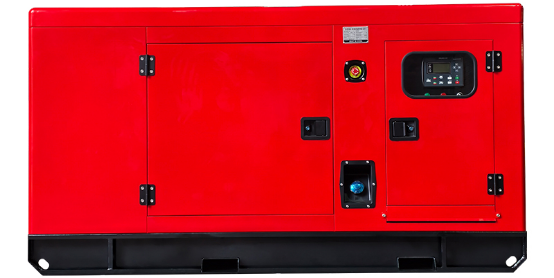
An 80kW silent canopy genset — ideal for supermarket rear-yard installations where noise limits apply. View full specifications.
A quality canopy diesel generator achieves 70–75 dB(A) at 7 meters — comparable to a busy street — through acoustic insulation, baffled airflow, and effective exhaust silencing. Placed behind the store with a simple barrier wall, it is unobtrusive even in dense urban settings. Our 20kW silent diesel generator and 16kW compact silent model suit convenience-store formats, while the 80–100 kW silent units cover full-size supermarkets.
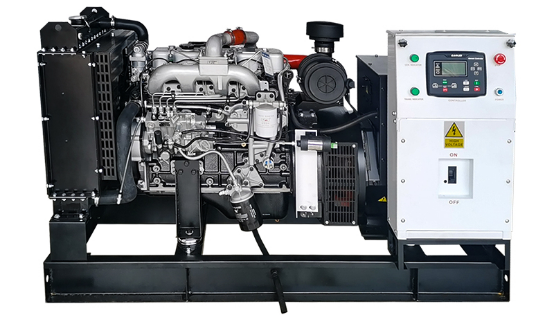
If the store has a dedicated, acoustically treated plant room with proper ventilation, an open-frame set is cheaper and easier to service. This suits larger retail centers and distribution warehouses — see a typical open-frame configuration in our 40kW export diesel generator, a popular model for export buyers fitting their own enclosures.
Locate the genset away from flammable stock rooms, install a bunded fuel tank or containment tray, and fit anti-vibration mounts — fuel vapors and transmitted vibration into refrigeration pipework are two of the most common installation mistakes we see in retail retrofit projects.
A diesel genset consumes roughly 0.25–0.30 liters per kWh produced at typical loads. For the worked example above — 68 kW essential load — expect about 18–20 liters per hour of outage. Practical autonomy planning:
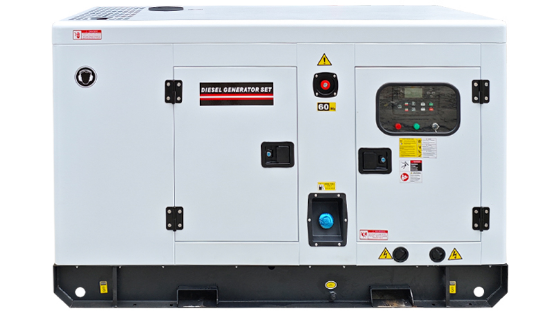
A 32kW silent generator — the workhorse class for convenience stores and small grocery outlets. See the 32kW model.
China supplies a large share of the world's standby gensets, and the price-to-specification ratio is strong — but quality varies enormously between assemblers. Established in 2010 in Guangdong, Guangdong Longhong Electromechanical Equipment Co., Ltd. builds generator sets from 3 KVA to 3000 KVA with genuine Cummins, Weichai, Yuchai, Perkins, Volvo, and Yunnei engines, CE and ISO certification, and more than 200 units in permanent stock for fast dispatch. Export experience spans Cambodia, Vietnam, Myanmar, Tanzania, and Libya, including a documented 400KW/500KVA Yuchai silent generator project and a 500KVA silent installation for a school — both directly relevant to noise-sensitive institutional sites like supermarkets.
For a supermarket or grocery store, backup power is not an optional convenience — it is insurance on the entire refrigerated inventory and on customer trust. Size the genset on Tier 1 and Tier 2 loads, add a proper motor-starting margin, choose a silent canopy for neighborhood compatibility, automate the start with an ATS, and buy from a manufacturer who can prove engine authenticity, canopy performance, and factory testing. If you are planning a supermarket, convenience chain, or cold-chain distribution project, contact Longhong Power for a sizing proposal and quotation — our engineering team routinely designs retail backup systems from 16 kW convenience-store units up to multi-megawatt distribution centers.
About Guangdong Longhong Electromechanical Equipment Co., Ltd.
Founded in 2010 in Guangdong, China, Longhong Power is a professional diesel generator manufacturer with 20+ years of industry experience, producing diesel generator sets from 3 KVA to 3000 KVA powered by Cummins, Weichai, Yuchai, Perkins, Volvo, and Yunnei engines. All products are CE and ISO certified, available as open frame, silent/canopy, trailer, and containerized types, with 200+ units in permanent stock and exports to Cambodia, Vietnam, Myanmar, Tanzania, Libya and beyond. Visit www.longhongpower.com to learn more.