

 English
 العربية
 Español
 Русский
Industry News
Industry News

A regional shopping center in Southeast Asia loses roughly USD 8,000 to 15,000 in revenue every hour the lights go out — and that's before counting spoiled frozen goods, angry tenants, and the public-relations nightmare of shoppers stuck in elevators. For mall operators, hospitality groups, and retail property developers, a properly sized shopping mall backup diesel genset is no longer an optional luxury. It is the single most important insurance policy a building can carry.
This 2026 buyer's guide walks you through everything a non-technical project owner needs to know before investing in a diesel generator set for a retail environment. We cover load calculation, silent canopy noise rules, fire-safety compliance, ATS integration, fuel planning, and the practical realities of buying from a China diesel generator manufacturer such as Guangdong Longhong Electromechanical Equipment Co., Ltd. Whether you manage a single anchor store or a 100,000 m² mixed-use complex, the principles below will help you specify the right standby power system and avoid the costly mistakes we see in the field every week.
The retail industry has changed dramatically in the last decade. A typical mall today is not just a collection of shops — it is a critical infrastructure hub hosting supermarkets, cinemas, food courts, data centers for point-of-sale systems, refrigerated storage, electric vehicle chargers, and increasingly, rooftop solar arrays with battery storage. A power outage affects every single one of these systems within seconds.
Industry studies put the average revenue loss for an enclosed shopping mall at between USD 5,000 and USD 20,000 per hour, depending on foot traffic and tenant mix. Add the cost of:
A reliable standby diesel generator recovers all of this within 10 to 15 seconds of an outage, automatically and invisibly to shoppers.
Most national building codes — including those in China, the UK, Australia, and the Gulf states — now require emergency power for lifts, fire pumps, smoke extraction, and emergency lighting in any retail building over a certain size. Insurance carriers increasingly refuse coverage or charge punitive premiums for properties without certified backup generation. In effect, a shopping mall backup diesel genset is becoming a licensing requirement, not an option.
Before you can specify a generator, you need to understand what you actually want to keep running during an outage. Most mall operators split loads into three tiers:
| Tier | Typical Loads | Priority During Outage |
|---|---|---|
| Tier 1 — Life Safety | Fire pumps, smoke exhaust, emergency lighting, lifts, PA system | Must run continuously for the entire outage |
| Tier 2 — Business Critical | Refrigeration, POS systems, server rooms, security, EV chargers | Must run within 30 seconds |
| Tier 3 — Comfort / Optional | General lighting, HVAC, escalators, advertising screens | Run if capacity allows; shed if load is high |
A practical mid-sized mall of 30,000 m² typically requires 800 kVA to 1,250 kVA of emergency diesel generator capacity to cover Tier 1 and Tier 2 loads comfortably. Large regional centers often deploy two or three paralleled units in the 500 kVA to 800 kVA range for redundancy.
One of the most common sizing mistakes is treating the connected load as the running load. Lighting rarely runs at 100%, escalators cycle on and off, and HVAC is partially shed by building automation. Apply a demand factor of 0.6 to 0.75 to non-essential loads, but keep Tier 1 and Tier 2 systems sized at 1.0. This is where the engineering team at your China diesel generator factory should be helping you — request a load-list review before quoting.
The right standby diesel generator size is determined by three numbers: the largest single motor starting kVA, the steady-state running load, and the future expansion headroom. Get any one of these wrong and you end up with a unit that either under-performs or wastes fuel.
For most malls this is the fire pump or the chilled-water pump. A 75 kW motor can draw 4 to 6 times its rated power for the first few cycles (locked-rotor current). The generator must absorb this inrush without stalling. As a rule of thumb, the genset's standby kVA should be at least 2.5× the largest motor's running kW.
Sum the running kW of every load you want to keep online. Add a 20% expansion margin for tenant turnover and EV-charging growth. Round up to the nearest standard genset rating — 250, 300, 400, 500, 625, 750, 800, 1000, 1250 kVA are common frames.
Engines lose about 1% of power for every 100 m above 500 m elevation, and another 1% per 5 °C above 25 °C ambient. A mall in Riyadh, Dubai, or Mexico City needs a substantially larger engine than the same mall in coastal Vietnam. Always ask your supplier for an altitude-corrected rating. For projects above 3,000 m — common in mining hubs in the Andes — specify turbocharged, intercooled engines and confirm the manufacturer's high-altitude test certificate.
A 25,000 m² mall with a 75 kW fire pump, 280 kW refrigeration plant, 120 kW lighting, 60 kW lifts and 90 kW data/security loads requires roughly 625 kW of running power. Adding the inrush of the fire pump (450 kVA momentary) and a 20% margin points to an 800 kVA standby diesel generator such as the 100kW-class heavy industrial unit scaled up into a multi-module paralleled configuration.
Many malls sit inside or directly adjacent to residential neighborhoods. Local noise ordinances typically cap generator operation at 65 to 75 dB(A) at the property boundary. An open-frame industrial engine will produce 95 to 105 dB(A) at one meter — completely unacceptable in a built-up area.
A genuine silent canopy diesel generator enclosure reduces noise to 68 to 75 dB(A) at 7 meters. This is achieved through:
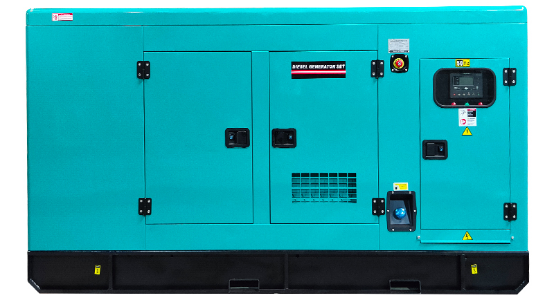
The 80 kW silent diesel generator and 32 kW silent generator in the Longhong product line are typical examples — both rated at 75 dB(A) at 7 m and certified for residential and commercial deployment.
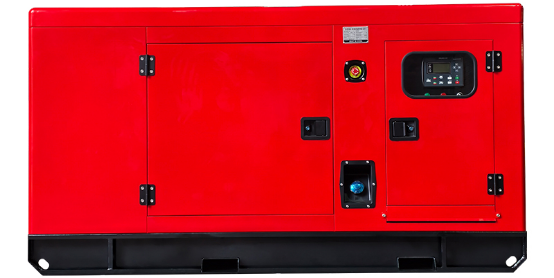
For larger 500 kVA+ units, a 20-ft or 40-ft ISO containerized enclosure is often the most practical option. It ships pre-assembled, includes internal fuel tanks, day-tank piping, and acoustic baffles, and can be lifted directly onto a prepared concrete pad. These units are also ideal for rooftop installations where floor space is limited.
An Automatic Transfer Switch (ATS) is the brain that makes the whole system work. Within 5 to 15 seconds of detecting a mains failure, the ATS signals the generator to start, stabilizes voltage and frequency, then transfers the load. When mains returns, the sequence reverses and the engine cools down before stopping.
Open-transition (break-before-make) ATS is the standard, lowest-cost option. Closed-transition (make-before-break) ATS allows paralleling with the utility for a few cycles, eliminating even the momentary blink of lights. Closed-transition is required for hospitals and data centers but is also increasingly common in premium malls.
Large malls often use two or three paralleled generators for N+1 redundancy. The control system must include a power management module that decides which units to run, when to start the next one, and how to share load proportionally. Longhong's 64 kW automatic generator is a typical unit designed for parallel operation with a built-in digital controller.
Modern ATS controllers support 4G, Ethernet, and Modbus for remote monitoring. The facility manager's phone receives an alert if the generator fails to start, the fuel level drops, or a fault code is logged. This is no longer a premium feature — it is expected.
A diesel generator in a retail building is subject to strict fire-safety rules. The non-negotiable items are:
Ask your supplier for a compliance matrix specific to your country — UK, GCC, ASEAN, and African codes differ in important details, especially around fuel-tank bunding and battery-vented enclosures.
Even the best generator will fail if installed poorly. Three things matter most:
The genset should sit on a concrete plinth at least 200 mm thick, with spring or rubber anti-vibration mounts between the skid and the concrete. Without this, vibration travels through the building structure and becomes a noise complaint from tenants upstairs.
A 1,000 kVA genset at full load burns around 220 L of diesel per hour. A 24-hour autonomy requirement therefore needs a 6,000 L bulk tank plus a 1,000 L day tank. For shopping malls, 8 to 12 hours of autonomy is the industry norm — long enough to ride out most grid disturbances and short enough to require fuel delivery within a typical recovery window.
Run the genset under load for at least 30 minutes every month. Change oil and filters every 250 hours or 12 months. Test the ATS monthly. Replace coolant every 2 years and batteries every 3 years. Log every run-hour in a maintenance book — it is the first document an insurance assessor will ask for after any incident.
Buying from a China diesel generator manufacturer with a local service partner dramatically simplifies this. Longhong's qualifications and certifications page lists CE and ISO approvals, and the company ships with a full O&M manual plus a recommended spare-parts kit.
China supplies more than 60% of the world's mid-range diesel gensets. The buying experience is very different from purchasing locally — and the savings (typically 30 to 50% versus equivalent Western brands) are too significant to ignore for budget-conscious mall projects.
For a single 500 kVA unit, a 20-ft open-top container is usually sufficient. Larger multi-unit orders may need a 40-ft HC unit. CIF (Cost, Insurance, Freight) to the destination port is the most common term; for landlocked projects, request DAP (Delivered at Place) to your project site.
Standard units: 15 to 25 working days. Custom silent canopy, containerized, or parallel-config units: 30 to 45 working days. Plan procurement at least 8 to 12 weeks before your target commissioning date to leave headroom for sea freight, customs clearance, and on-site installation.
A well-specified shopping mall backup diesel genset is the single most cost-effective insurance a retail property can buy. Get the sizing right with a proper load analysis, invest in a genuine silent canopy enclosure, integrate an automatic transfer switch, and source from a manufacturer with verifiable reference projects.
Guangdong Longhong Electromechanical Equipment Co., Ltd. has been building diesel generator sets from 3 kVA to 3,000 kVA since 2010, exporting to Cambodia, Vietnam, Myanmar, Tanzania, Libya and beyond. The company holds CE and ISO certifications, stocks 200+ units permanently, and supports Cummins, Weichai, Yuchai, Perkins, Volvo, and Yunnei engines. Browse the full product catalog at https://www.longhongpower.com/products_27/, request a quotation for your mall project, and let the engineering team size the right standby system for your retail center.


