

 English
 العربية
 Español
 Русский
Industry News
Industry News

Every generator catalogue is written for a laboratory. The rating printed on the nameplate assumes 25°C inlet air, 100 kPa barometric pressure and 30% relative humidity — conditions that a large part of the world's difficult sites never experience. Move the same machine to a mine at 1,800 m, a jetty in the Gulf at 45°C, or a plateau project above 5,000 m, and that number stops describing the equipment and starts describing an intention.
De-rating is the difference between the two, and it is ordinary engineering rather than a defect. This guide is for buyers, consultants and contractors who specify power in conditions the brochure does not cover: how much output disappears, how the arithmetic works, and which purchase-order clauses force a supplier to commit to a figure at site conditions rather than at sea level.
Guangdong Longhong Electromechanical Equipment Co., Ltd. has built diesel generator sets from 3KVA to 3000KVA since 2010, including units specified for high-altitude mining, desert and coastal export projects.
ISO 8528-1 defines the rating of a generating set at a total barometric pressure of 100 kPa, an air temperature of 25°C and a relative humidity of 30%, and ISO 3046-1 applies the same reference to engine output. Those are mild, low-altitude, temperate values. A set rated 200 kW is guaranteed to produce 200 kW at the bottom of a cool day near sea level — nowhere else. The same standard obliges the manufacturer to publish derating data, and that data is where the real specification lives.
Quotations are compared on nameplate kVA because nameplate kVA is the only figure that is easy to compare. Two suppliers offering "250 kVA" may be offering 250 kVA at 25°C and 210 kVA at the temperature the site actually reaches. When the plant is commissioned, the shortfall shows up as an overload trip at 85% of expected load, black smoke under motor starting, exhaust temperature alarms, or an engine needing a top-end overhaul at 4,000 hours instead of 10,000. None of those symptoms reads as "sizing error" on a maintenance report, which is why the mistake repeats.
Specify at site conditions from the first enquiry. State the altitude, maximum ambient, humidity, enclosure type and installation arrangement, then require the supplier to quote net output in kW and kVA at exactly those conditions. An honest factory returns a smaller number and an explanation; a trader returns the catalogue figure and a promise.
A diesel engine is an air pump with a fuel valve attached. At 2,000 m the air holds roughly three-quarters of the oxygen available at sea level; at 4,000 m about two-thirds; at 5,300 m barely 60%. The fuel rack can only deliver what the air can burn, because the smoke limit is reached before the torque limit. Typical published curves for turbocharged engines lose about 10% of rated output at 2,000 m and 25–30% at 4,000 m, with naturally aspirated engines losing roughly twice as much. Altitude then charges a second time on the cooling side: the radiator has the same surface area but thinner air to carry heat away, so heat rejection falls in step with density unless the core and fan are upsized.
Hot air is thin air. Above the 25°C reference, turbocharged engines typically lose around 1% of output per 5°C and naturally aspirated engines closer to 2%. A 45°C afternoon therefore costs 4–8% before anything else is considered, and it widens the gap between radiator air-on and air-off temperatures, which is the margin deciding whether the set holds full load at 3pm. A canopy or container adds a further 8–12°C to the air the radiator sees, which is why "it worked on the test bed" and "it works in the yard" are different claims.
Water vapour displaces air, and very humid inlet air can cost 1–2% of output — modest, but not zero when it stacks on altitude and heat. The bigger effects are mechanical: wet-bulb temperature governs how well the radiator rejects heat, so a 90% humidity coastal site can lose cooling capacity even at moderate dry-bulb readings; condensate forms in charge-air coolers and inlet ducts, producing white smoke and corrosion; and standing moisture in fuel tanks and control cabinets attacks the electrical systems unmanned sites depend on. Tropical coastal installations need anti-corrosion and ingress protection treated as part of the derating discussion.
Louvre free area below 1.5 times radiator face area, undersized discharge ducting, exhaust aimed back at the radiator intake, or a canopy parked against a wall in direct sun can cost 10–15% of usable capacity on its own. This is the most common and least discussed derate in the field, created by the installer after the factory has shipped a correct machine. Treat airflow as a hard design input with dimensions on the drawing.
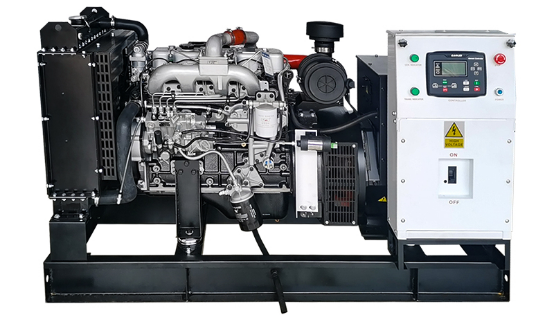
An open frame set shows the radiator and airflow path clearly — useful when installation derating has to be calculated rather than assumed.
Take a 100kW silent diesel generator rated 125 kVA at 0.8 power factor, offered for a plant at 1,800 m with a 40°C design ambient. Engine side: altitude costs roughly 9% and temperature another 3%, so net output lands near 88 kW. Alternator side: rated at 40°C and 1,000 m, the 800 m of extra altitude costs a few percent while temperature is already at the rating point, so the generator end holds about 120 kVA — comfortably above what the engine can deliver. The engine binds, and the honest specification is "88 kW at site conditions", not 100 kW.
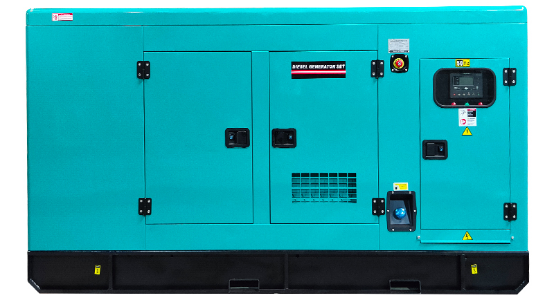
A 100kW silent diesel generator rated 125 kVA at 25°C and sea level — at 1,800 m and 40°C the same machine is an 88 kW set.
High-altitude mining is where derating stops being theoretical. At 5,300 m a turbocharged engine loses roughly a third of its rated output, and the cold, thin air that helps combustion temperature does not restore the missing mass flow. A 400 kW nameplate machine delivers in the region of 250–270 kW there. That is the engineering behind the Weichai generator installed in a mining area at 5,300 m altitude: the set is deliberately oversized against the site load, matched with an altitude-compensated turbocharger and a cooling package validated for thin air, because a machine sized on the catalogue figure would have run at 100% load from arrival and failed within a season. Cold-start provisions — jacket water heater, battery heating, fuel conditioning — belong to the same specification.
A 32kW silent generator specified for a coastal pumping station at 45°C and 90% relative humidity loses roughly 4% to temperature at the engine, 1–2% to humidity, and a further 3–5% if the canopy sits in unshaded sun with restricted louvre area. Realistic capacity is about 28 kW. The site also needs the alternator quoted for a 45°C or 50°C ambient rather than the standard 40°C rating, plus a corrosion class finish for enclosure, cable entries and fasteners.
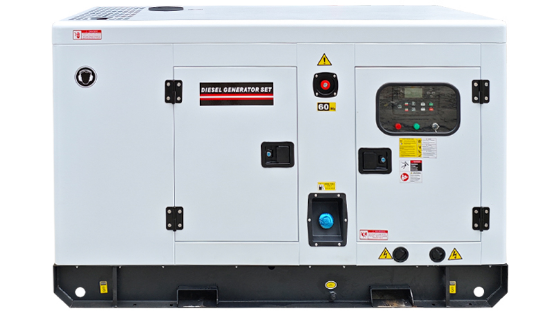
A 32kW silent generator in a canopy: at 45°C and 90% relative humidity, expect about 28 kW of usable capacity unless the cooling package is upsized.
A turbocharger compresses inlet air back toward sea-level density, so the engine recovers part of what altitude removed. That is why the derating curves of turbocharged engines are roughly half as steep as those of naturally aspirated units, and why above about 1,500 m the turbo is not a performance option but a precondition. The benefit is bounded by the compressor map: once the turbo reaches its surge or overspeed limit, further altitude brings the full penalty back.
Compression heats the air, and hot air is again thin air, so an aftercooler is what converts boost pressure into oxygen mass. At altitude it also becomes a condensation point in humid climates, which is why drain provision matters. The injection pump must be set for the site too: a rack setting from a sea-level test cell delivers too much fuel for thin air and produces visible smoke, high exhaust temperature and carbon loading. Ask for the altitude and ambient at which the fuel setting is calibrated, and for exhaust temperature at rated load under those conditions.
Three numbers settle the argument: net output in kW at site conditions, exhaust gas temperature at that output, and the largest block load the set accepts at the site. A supplier who answers all three has engineered the machine; one who answers only the first has copied a table.
Alternators are normally rated for a 40°C ambient at 1,000 m, with insulation class H windings and a defined temperature rise. Above that ambient the winding runs hotter for the same current, and the derating table removes a few percent of kVA for every 5°C. Above 1,000 m, thin air cools the windings less effectively and raises the risk of corona at high winding voltages, so a second correction applies. Marine and tropical specifications often start from a 45°C or 50°C rating precisely to avoid living on the margin.
Every set has two ceilings — engine kW and alternator kVA — and the site derates them at different rates. Hot sites usually erode alternator kVA first; high-altitude sites erode engine kW first. The usable rating is the lower of the two after both corrections, presented as a single figure at a stated power factor. Comparing 0.8 pf kVA against a kW load without that conversion is one of the quiet ways projects end up short.
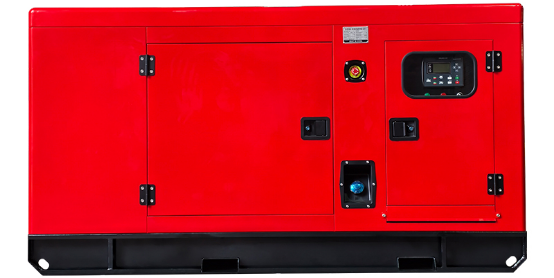
An 80kW silent diesel generator — at 40°C ambient and 1,800 m the engine, not the alternator, sets the usable rating.
An upsized radiator core, a higher-capacity fan, a remote or split radiator outside the enclosure, and louvre free area of at least 1.5 times the radiator face all raise the temperature at which full load can be held. On a canopy unit, insulated hot-air discharge ducting keeps exhaust and radiator air from recirculating. These changes usually cost less than the next frame size and, unlike oversizing, do not create a lightly loaded engine.
Buying 40% more capacity than the load needs protects against derating and creates a different problem: a diesel engine run below about 40–50% load for long periods glazes its cylinders, dilutes lubricating oil with unburnt fuel and wet-stacks the exhaust. A generous altitude margin is correct; an arbitrary one is not. Derate the load and the set at the same conditions, hold loading in the 60–80% band in normal operation, and use a load bank for the rest.
Where the site is marginal, sequencing buys capacity: start the largest motor last, interlock chillers or pumps so they cannot step together, fit soft starters on the biggest drives, and move non-essential loads to a shed bus. A 250 kW load stepping 120 kW at once demands a different machine from the same load stepping 40 kW at a time.
Put a table in the enquiry: altitude in metres, maximum and minimum ambient, relative humidity, enclosure type, installation location, fuel grade and required autonomy. Then require these in the quotation, not in a later email: net prime and standby output in kW and kVA at those conditions; the derating basis used (ISO 3046-1 and ISO 8528-1 corrections); alternator ambient and altitude rating; exhaust temperature at rated load; maximum block load accepted; and cooling validated at site ambient with the enclosure fitted.
A factory acceptance test at sea level proves workmanship, not site performance. Where conditions are extreme, ask for the test at the highest ambient the cell can reach, with correction curves supplied, and witness the figures that matter: full-load exhaust temperature, voltage and frequency recovery after a block load step, and fuel consumption measured rather than quoted. The certifications and test documentation should travel with the machine.
Chinese factories build for exactly these markets, and the reliable ones quote a site rating without argument. Compare the generator product range by frame and by engine, confirm the manufacturer's company background and export record, and look for evidence of comparable conditions rather than generic references — the 750KVA Cummins export project for Libya shows desert-heat packaging, while the plateau mining installation shows altitude engineering in practice. Engine choice still matters for serviceability: Cummins, Weichai, Yuchai, Perkins, Volvo and Yunnei are all available, and the nearest parts network usually decides the argument at 4,000 m.
De-rating is not a negotiating tactic and not a sign of a weak machine; it is the physical cost of the site. Altitude removes oxygen, heat thins the air and shortens the cooling margin, humidity attacks the systems that keep an unmanned site running, and a badly ventilated enclosure removes whatever was left. Do the arithmetic before the purchase order, state the conditions in writing, and require the supplier to quote output at those conditions. A set honestly rated for the site runs at 70% load for fifteen years; a set optimistically rated runs at 100% load for two. The Longhong Power team sizes every set against the site table rather than the catalogue, from a 16kW compact silent diesel generator for a mountain lodge to containerized megawatt packages for industrial plants.
Founded in 2010 in Guangdong, China, Guangdong Longhong Electromechanical Equipment Co., Ltd. manufactures open frame, silent canopy, trailer and containerized diesel generator sets from 3KVA to 3000KVA with Cummins, Weichai, Yuchai, Perkins, Volvo and Yunnei engines. CE and ISO certified, with 200+ units in permanent stock and exports to Cambodia, Vietnam, Myanmar, Tanzania, Libya and more. Browse the product range to match a diesel generator set to your altitude, ambient temperature and load profile.


