

 English
 العربية
 Español
 Русский
Industry News
Industry News

A data centre is the only building where a two-second voltage sag becomes a support ticket and a fifteen-second outage becomes a headline. That asymmetry rewrites every rule of generator selection: the load is steady but unforgiving, the cooling plant restarts in violent steps, and the facility's commercial promise rests on a machine that may run fewer than fifty hours a year.
This guide is written for the people who specify and buy these systems — colocation operators fitting out a hall, enterprise teams building a first edge site, contractors pricing a turnkey package, and international buyers sourcing industrial emergency diesel generator capacity from China. It covers load behaviour, redundancy economics, sizing around step loads, and purchase-order discipline.
Guangdong Longhong Electromechanical Equipment Co., Ltd. has assembled power generator packages for industrial, infrastructure and export customers since 2010, building generator sets from 3KVA to 3000KVA with CE and ISO certification.
Most standby applications ask a generator to survive an outage. A data centre asks it to be indistinguishable from the grid for as long as the fuel lasts.
IT load barely moves. Servers do not cycle like compressors or weld like a fabrication shop, so once transfer is complete the generator sits at a steady 60–80% of rating for hours. That is a healthy place for a diesel engine to work, and it is why data centre sets must never be oversized: an oversized set runs cold, glazes its cylinders and produces the wet stacking that fouls the exhaust and dilutes the lubricant. Correct sizing means deliberately loading the machine, not protecting it.
The hard moment comes immediately after transfer. Chilled-water pumps restart, computer-room air conditioners spin up in groups, and UPS rectifiers begin recharging batteries that have just discharged. That recharge alone can add 20–30% to the load within seconds. A set specified against the steady-state figure will stumble on the recovery rather than the outage. Block load acceptance — the largest single step the machine absorbs without exceeding transient limits — is the number that matters, and it belongs in writing.
ISO 8528-1 separates standby power (limited hours, no overload), prime power (unlimited hours with a defined overload allowance) and continuous power, and the 2018 revision added a data centre power rating for this duty pattern. An operator running through a multi-day utility failure is buying prime-rated capacity whether the tender says so or not; a standby-rated set pressed into that service has its warranty invalidated by the hours it accumulates. Because a failed hall costs service credits and customers rather than a spoiled pallet, the purchase is judged on demonstrated behaviour and on the certifications and test documentation that accompany the machine.
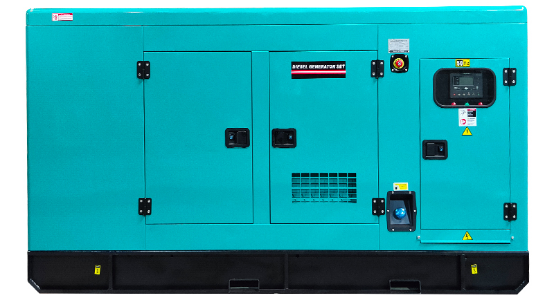
A 100kW silent diesel generator set — the class typically used for edge data rooms and small enterprise server halls where a single set plus UPS covers the load.
Availability tiers translate into generator count with brutal directness. N has one block of capacity and no spare; N+1 adds a redundant unit that can be paralleled in or take over; 2N duplicates the entire path so either half carries the hall alone. Each step up roughly doubles generator capital cost, fuel storage and switchgear, so the decision must be made before the single-line diagram is frozen.
Four 500kW sets in parallel deliver the capacity of two 1MW machines with finer granularity: one unit goes offline for service while the hall stays protected, and part-load efficiency improves because the controller runs only the engines the load needs. The cost is control complexity — synchronisation across voltage, frequency and phase angle, load sharing through governor and voltage regulator droop, and a master controller that sequences start and stop without hunting.
Redundancy diagrams stop at the machine; real outages do not. One shared fuel header feeding every set, one automatic transfer switch, one exhaust discharge recirculating into the radiator intake, one tank filled with the wrong grade — any of these converts a 2N plant into an N plant with extra steps. Audit the fuel path, the transfer path and the airflow path with the severity applied to the engines, and count the footprint early: a 1,000kVA canopy unit needs clearance its rating does not advertise.
Take a 400 m² hall designed for 600kW of IT load. At a power usage effectiveness of 1.4, total facility demand is 840kW: 600kW of servers and network equipment, 240kW of cooling, pumps, losses and lighting. That 840kW is the figure the generator must hold indefinitely, not the 600kW on the IT schedule.
After transfer the batteries recharge while the cooling plant restarts. Budget the recharge at 20–25% of IT load for 30–60 minutes — roughly 130kW here — plus the largest chiller or pump step, perhaps another 150kW for a few seconds. The steady requirement stays at 840kW; the transient peaks near 1,120kW. A set that holds 1,000kW continuously but accepts only a 400kW step is a worse purchase than a smaller machine accepting 700kW, because the failure mode is the step.
With N+1 architecture, two 800kW prime-rated sets cover the 840kW hall with one redundant unit, each running near 60% when both are online and near 85% when one is isolated — both above the 50% threshold where wet stacking becomes a real risk. Three 500kW sets achieve the same protection with more granularity. A pair of 1,250kW sets does not, because normal operation would leave them idling near 34%. Ratings are published at reference conditions, so restate them: at 40°C ambient the alternator derates, at 2,000m the engine loses roughly 10% of output.
When the grid fails, the uninterruptible power supply carries the IT load while the generator starts and the transfer switch operates. Battery autonomy is therefore the deadline for the whole mechanical sequence. A conventional string gives five to ten minutes; a generator needing forty seconds to come online leaves comfortable margin, one that hunts for two minutes does not. Where NFPA 110 applies, a Level 1 system must accept load within ten seconds, and transfer equipment, controller and fuel system all have to be designed to that clock.
The correct order is: mains fails, UPS takes the load, the generator cranks to rated voltage and frequency, the automatic transfer switch verifies the source, transfer occurs, rectifiers recharge, cooling restarts in stages. Every element must be tested as a chain, because a generator that starts perfectly but meets a switch with a mis-set voltage window will sit there running while the batteries drain — a failure reported as "generator healthy, site down". Facilities that cannot tolerate a break use closed-transition transfer, and every serious design includes a maintenance bypass so the switch can be serviced without dropping the hall.
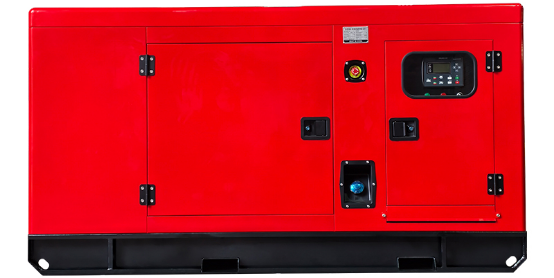
An 80kW silent diesel generator with an auto-start controller — a typical single-set solution for an edge facility or data room with a 60–70kW critical load.
Consumption runs 0.25–0.30 litres per kWh delivered, so an 840kW hall burns roughly 210–250 litres an hour. Twenty-four hours of autonomy needs 5,000–6,000 litres; forty-eight hours needs double, plus a 10% unusable heel and bunding at 110% of tank volume. Most operators settle on 24–48 hours on site behind a contracted refuelling agreement — but the contract is worthless if the delivery cannot reach the tank during the event that took the grid down.
Diesel held for a year oxidises, absorbs water through breathing, and grows the microbial film known as diesel bug. In a data centre, where the generator may not run for months and then must perform perfectly, fuel quality is a maintenance item rather than a consumable. Specify a day tank fed through a filter-separator, a polishing loop for the bulk tank, water-level detection, and a quarterly test for clarity, water content and microbial growth.
A generator converts roughly a third of its fuel energy into electricity and rejects the rest through radiator and exhaust. Recirculation is the classic installation error: exhaust discharged toward the radiator intake raises intake temperature until the set derates or trips — usually on the hottest day of the year, which is the day demand peaks. Design discharge away from intakes and neighbouring units, respect clearance figures, and check that acoustic cladding added on site has not obstructed the louvre area. Canopy units at 65–75 dB(A) at seven metres cover most municipal limits; tighter boundaries need a containerized acoustic package or a purpose-built plant room.
A containerized diesel generator packages engine, alternator, radiator, control room, fuel connections and acoustic treatment into an ISO footprint that ships, lifts and bolts down like freight. For a data centre the real value is moving commissioning risk off the critical path: the unit arrives tested, is set on a plinth, connected and started. It also allows incremental build-out — add a module when the hall fills rather than buying capacity the load cannot yet use. Confirm CSC plating, walk-in service access, fire detection and cooling validated at site ambient.
Below roughly 400kW, a silent canopy unit is the pragmatic default for edge sites and server halls: weatherproof, acoustically treated and ready for a concrete pad. The trap is assuming canopy equals indoor quality, because a canopy in direct sun at 45°C ambient needs its derating calculated rather than estimated. Standard silent sets in the 32kW to 100kW range — such as the 100kW silent diesel generator and the 80kW silent diesel generator — cover most edge deployments, while the 32kW silent generator suits network rooms under 25kW of critical load.
Where a dedicated, ventilated and acoustically treated plant room exists, an open frame set delivers the same electrical performance for less money and with better service access; the prerequisite is genuine, since combustion air, radiator air, exhaust routing, cable entry and fire separation all have to be engineered. Mobile trailer diesel generators cover three other roles: temporary protection during a generator swap, disaster recovery after a regional event, and bridging power for a hall whose permanent plant is delayed. A trailer set needs road-legal axle loading and a control interface matching the site's transfer scheme.
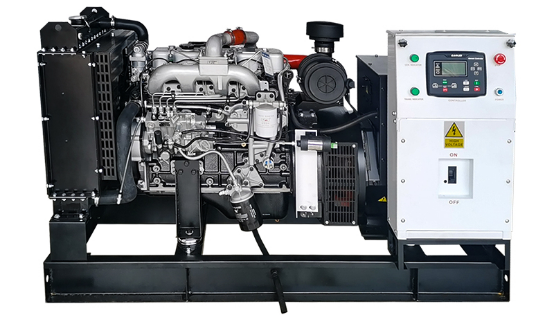
An open frame diesel generator set — the most cost-effective and most serviceable option when a purpose-built, ventilated plant room is part of the design.
Commissioning a data centre generator means more than a no-load run. The programme includes a cold start at site ambient, stepped loading in blocks that mirror the real recovery sequence, a full-load run of at least four hours to prove thermal stability, verification of every protection shutdown, a transfer test with the UPS carrying the load, and a fuel consumption measurement against the quoted figure. A 100% test with recorded transient response is the most valuable document the operator will own. Afterwards: weekly start-and-run, monthly on-load transfer with a written log, annual full-load test with fuel analysis, and controller telemetry so a failed self-test at 3am raises an alert instead of waiting for an outage to reveal it.
Chinese manufacturing quality in this sector ranges from excellent to unacceptable, and the difference is visible in a factory acceptance test: cold start, stepped load to 100%, protection trips, fuel consumption, and a walk-round of paint, door seals, loom dressing, battery isolation and nameplate against order. The 400KW/500KVA Yuchai silent generator installation and the 100KVA Cummins export project delivered to Tanzania show the class of documented project buyers should treat as the baseline. Compare the full generator product range against your load list, and check the manufacturer's company background and export record rather than a trading company's brochure.
Data centre power protection is decided in four numbers: facility load after power usage effectiveness, the largest step the plant demands on recovery, the minutes of autonomy the battery actually provides, and the litres of fuel the site can hold. Get those right and the generator becomes a boring machine that works. Get them wrong and no redundancy in the single-line diagram will save the hall, because the failure arrives as a stumble on a step load or a tank that ran dry on day two. The discipline is to buy a correctly rated automatic generator, prove it under load before acceptance, then treat fuel quality and weekly self-tests as seriously as the servers.
Founded in 2010 in Guangdong, China, Guangdong Longhong Electromechanical Equipment Co., Ltd. manufactures open frame, silent canopy, trailer and containerized diesel generator sets from 3KVA to 3000KVA with Cummins, Weichai, Yuchai, Perkins, Volvo and Yunnei engines. CE and ISO certified, with 200+ units in permanent stock and exports to Cambodia, Vietnam, Myanmar, Tanzania, Libya and more. Browse the product range to match a diesel generator set to your data hall, edge site or colocation project.


