

 English
 العربية
 Español
 Русский
Industry News
Industry News

By Guangdong Longhong Electromechanical Equipment Co., Ltd. | Updated October 2026
A modern greenhouse is a life-support system for plants. Ventilation fans, irrigation pumps, nutrient dosing, supplemental lighting and heating — all of it depends on electricity, and most of it fails within hours, not days, of a grid outage. In summer, a greenhouse without fans can cook a full crop in under two hours; in winter, a heating loop that stops circulating can freeze seedlings overnight. That is why a properly sized standby diesel generator is not an optional accessory for commercial growers — it is insurance on the entire season's revenue. This guide explains how to assess a greenhouse's electrical load, size a diesel generator set correctly, choose between open frame and canopy configurations, and what to check when buying from a China diesel generator manufacturer. The principles come from our own experience as a factory established in 2010, supplying gensets from 3KVA to 3000KVA to farms and agribusinesses across Southeast Asia, Africa and the Middle East.
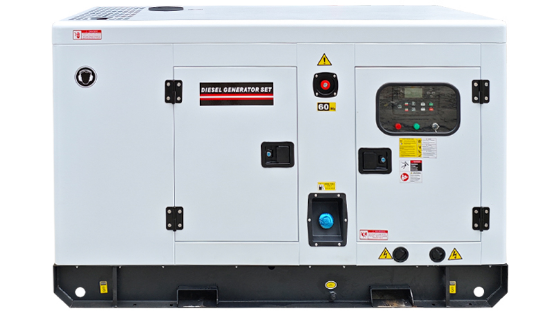
Grid outages hit greenhouses harder than almost any other agricultural facility because the building itself amplifies the failure. A warehouse loses lighting and a greenhouse loses its climate. The damage curves differ sharply by season:
The conclusion for buyers is simple: a greenhouse emergency diesel generator must start automatically and restart the critical loads quickly. Manual start-up procedures fail precisely when they are needed most — at night, in storms, when staff are off-site.
Before you can size a diesel power generator, you need a honest inventory of what must run during an outage. Greenhouse loads fall into three tiers, and the third tier is where most buyers make sizing mistakes:
Climate controllers, sensor systems, boiler controls, and at minimum a portion of ventilation. These loads are modest in kilowatts — often just 2–5 kW — but they must never drop, even for the seconds it takes a generator to start. Anything with a microprocessor should sit behind a small UPS (uninterruptible power supply) that bridges the 10–15 second transfer window.
Ventilation fans, circulation pumps, irrigation pumps and heating system pumps. These are the kilowatt-hungry loads that dominate sizing. Fans running continuously draw steady current, but pumps that start and stop in cycles draw a large inrush at every restart — typically 2 to 3 times their rated running current for direct-on-line starting.
Supplemental lighting, packaging lines, office equipment and refrigeration for harvested product. Lighting is the classic mistake: an HID or LED supplemental lighting array can double a greenhouse's connected load, yet it is one of the few loads that can simply stay off for a few hours without killing the crop. Buyers who include lighting in the standby calculation routinely oversize their genset by 50–100% and pay for it in fuel for the life of the machine. Either exclude lighting from backup, or wire it on a separate sheddable circuit your auto-start diesel generator controller can prioritize.
Small market-garden operations under roughly 10 kW of backup load run comfortably on a single-phase diesel generator feeding domestic-style circuits. Commercial greenhouse ranges above 10 kW — and any site with three-phase fans, pumps or well motors — should specify a three-phase diesel generator, which balances load across the windings and runs motors more efficiently. Most greenhouse equipment sold internationally is available in both configurations, so decide phase first, then buy equipment to match, not the reverse.
Sizing follows the same motor-load logic we apply to any agricultural facility. Here is a worked example for a 2,500 m² commercial vegetable greenhouse range:
| Load | Running kW | Starting Factor | Sizing kW |
|---|---|---|---|
| Exhaust and circulation fans (8 units) | 12.0 | 1.2 | 14.4 |
| Irrigation pump (DOL start) | 5.5 | 2.5 | 13.8 |
| Heating circulation pump | 1.5 | 2.0 | 3.0 |
| Climate controller + sensors (UPS-backed) | 1.0 | 1.0 | 1.0 |
| Nutrient dosing station | 1.5 | 2.0 | 3.0 |
| Staff facilities / sockets | 2.0 | 1.0 | 2.0 |
Running total is 23.5 kW, but the sizing total is 37.2 kW once motor-starting margins are applied. The correct specification is a genset rated at least 40 kW, sized to hold voltage stable while the irrigation pump kicks in under full fan load. A 40 kW-class unit — such as our 40kW export diesel generator — covers this example with margin, and its weatherproof open-frame build suits a machinery shed installation.
Two rules keep greenhouse sizing honest. First, never load a standby genset below roughly 30% of its rating for long periods — chronic under-loading causes wet stacking and glazing in diesel engines. If your Tier 1 + Tier 2 loads total only 12 kW, a 100 kW machine is the wrong answer; a 30kW silent generator sized for farm duty will run more efficiently and last longer. Second, confirm whether the genset will carry everything or only the critical tiers — shedding lighting and packaging loads can halve the required rating, and halve the purchase price with it.
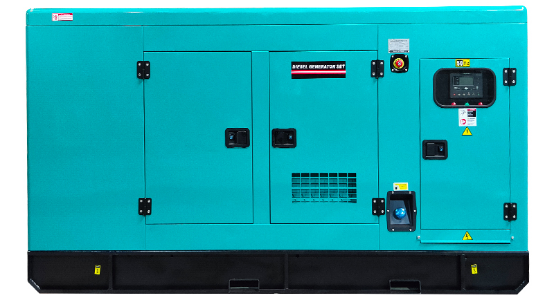
Greenhouses are unattended for more hours of the week than they are staffed, which makes automation the single most valuable feature in the control system. Three functions matter:
A genset with an AMF (automatic mains failure) controller monitors the grid continuously. When utility power fails, it cranks the engine within seconds, settles voltage and frequency, and signals the ATS (automatic transfer switch) to connect the greenhouse loads — the whole sequence completes in 10 to 15 seconds. When grid power returns, it transfers back, runs a cool-down period and shuts down without human touch. Every unit we build at our generator factory above 20 kW can be fitted with this control package, and our 64kW automatic generator ships with auto-start as standard for exactly this class of unattended application.
On smaller gensets, a controller with configurable outputs can drop Tier 3 circuits automatically, keeping fans and pumps alive while lighting waits. This effectively lets a mid-size genset protect a facility whose full connected load exceeds its rating — a common strategy for growers retrofitting backup power on a budget.
Modern controllers support SMS or network alerts for start failure, low fuel, high coolant temperature and low oil pressure. A notification at 2 a.m. beats discovering a dead house at 7 a.m. For remote sites without staff, this feature alone justifies a modest upgrade in controller specification.
Open frame units are the most economical and the easiest to service, and they suit installation inside a machinery shed, plant room or purpose-built enclosure where weather and noise are already managed. If your greenhouse has a covered utility building, an open frame diesel genset gives the lowest cost per kilowatt. They are not suitable for outdoor exposure as-delivered — rain and dust will shorten engine life dramatically.
A canopy diesel generator packages the engine, alternator and fuel tank in a weatherproof, sound-attenuated enclosure. For greenhouses located near residential areas, farm stays, or staff housing, the 65–75 dB(A) rating at 7 meters keeps neighbor relations and worker comfort intact. The weatherproof canopy also removes the need for a dedicated building, so placement can sit close to the fan and pump distribution boards — shorter cable runs, lower installation cost.
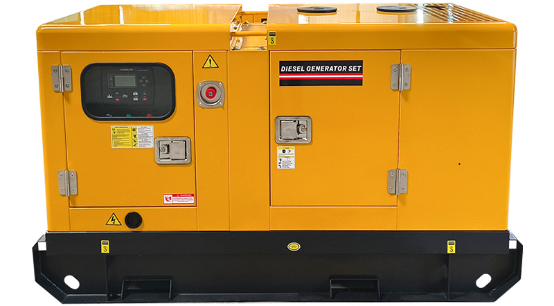
Multi-site growers — nursery groups, flower farms with several locations, agribusiness contractors — increasingly buy one mobile trailer diesel generator and move it between sites seasonally, or hold it as a shared reserve. Containerized units suit very large horticultural estates and integrated greenhouse-plus-packhouse operations where gensets run in parallel as a small diesel power plant. Our range covers all four configurations, and the product catalog lists ratings from 3KVA up to 3000KVA with Cummins, Weichai, Yuchai, Perkins, Volvo and Yunnei engine options.
Diesel fuel autonomy is the number of hours your genset can run the critical loads on its tank. Plan for a minimum of 24 hours of Tier 1 + Tier 2 running without refueling, and 48–72 hours where roads can flood or snow in. As a planning figure, a diesel generator consumes roughly 0.25–0.30 liters per kWh produced; the 37 kW worked example above therefore needs about 9–11 liters per hour, and a 500-liter tank gives roughly two days of autonomy. Canopy gensets include a base fuel tank, but external day tanks are a standard upgrade for growers with longer outage exposure.
Cold climates add two tasks. First, winter-grade diesel or fuel additives prevent gelling in sub-zero temperatures — the same advice we give in detail in our cold-climate buyer's guide. Second, specify a block heater and battery warmer so the emergency diesel generator actually cranks at -15°C. For highland growing regions, altitude also derates output — our Weichai-powered delivery to a mining site at 5,300 meters altitude demonstrates how proper derating calculations keep a genset honest where thin air costs 20–30% of sea-level rating.
China supplies a large share of the world's agricultural gensets, and the price advantage is real — but quality varies widely between assemblers. Before committing to a China diesel generator supplier, work through this list:
A greenhouse backup system is fundamentally simple: protect the climate, protect the water, automate the start. Tier your loads honestly, size the genset for motor starting rather than nameplate totals, insist on AMF auto-start control, and buy weatherproof hardware that will actually crank on the coldest night of the year. Do that, and a diesel generator set becomes what it should be for a grower — quiet insurance that you only notice when the grid fails and your fans keep spinning anyway. If you are planning backup power for a greenhouse, nursery or agribusiness facility, our engineering team can size a unit from your load list and quote a factory-direct export configuration; see the full product range or contact us through the website.


