

 English
 العربية
 Español
 Русский
Industry News
Industry News

A telecom tower without power is a tower without revenue. Batteries bridge the first minutes of an outage, but they are sized for hours, not days — and once they drain, every carrier sharing that site goes dark at once. Network operators learned this lesson through every major storm and grid failure of the past decade: the sites that stayed up were the ones with a properly sized, properly controlled diesel generator set on the ground.
Telecom power is unlike factory or building power. Loads are small but absolutely continuous, sites are often remote and unattended, fuel logistics dominate the running cost, and the generator may start itself several times a day without a human anywhere near it. This guide covers how base station loads differ, how to size a standby diesel generator for a tower site, what the control system must do on its own, which enclosure format survives a remote compound, and what to check when ordering from a China diesel generator manufacturer.
Guangdong Longhong Electromechanical Equipment Co., Ltd. has supplied power generator packages for telecom, industrial and export projects since 2010, with 200+ units in permanent stock and export experience across Cambodia, Vietnam, Myanmar, Tanzania and Libya.
The classic backup problem is delivering a large load occasionally. The telecom problem is delivering a small load continuously, often with nobody present, in places the road barely reaches.
A macro base station with three sectors of 4G/5G radios, transmission equipment and air conditioning draws 5 to 15 kW of real load — sometimes 20 kW at a busy hub site with heavy cooling. That is far below the rating of most commercial gensets, and light-load running is the quiet killer of diesel engines: below roughly 30% of rated load, combustion temperatures drop, fuel burns incompletely, and carbon and unburnt diesel slowly wreck injectors, valves and the turbocharger. A generator bought at double the site load for "safety" will spend its life in exactly this regime. The right approach is a small set sized close to the real load, or a larger set with load management — never an oversized machine idling at 15%.
A building's standby generator has facilities staff. A tower site has a security guard, if that. The emergency diesel generator at a remote compound must start on its own, run within its limits on its own, protect itself on its own, and report its condition to a network operations centre by SMS, GPRS or 4G. Anything that needs a human to press a button, check an hour meter or close a fuel valve does not belong on a tower site.
In many of the markets where towers are being built fastest, the grid is not simply present or absent — it cycles. Power may be stable for six hours, absent for four, restored, absent again. Each cycle is a start/stop event for the genset. A telecom auto-start diesel generator therefore accumulates in a year what a standby set in a stable-grid country accumulates in a decade, which changes every purchasing decision: engine class, maintenance interval, spares stock and fuel system all have to be specified for prime and intermittent duty, not for a machine that runs twelve hours a year.
Start from the equipment schedule: radio units (DC load, but the rectifiers that feed them are AC), transmission gear, one or two air conditioners, lighting, and a margin for the next generation of hardware. Air conditioning is the swing item — in hot climates the compressor can equal the entire telecom load. Convert everything to watts, note which items are single-phase and which are three-phase, and identify the largest single motor: that compressor will demand two to three times its running current at start-up unless it is inverter-driven or soft-started.
For most tower sites the answer lands in the 10 to 40 kW band, which is exactly the heart of a compact silent range:
The sizing target that matters: once running, the set should sit between 40% and 70% of rated load in the hottest month. Below 30% it slowly destroys itself; above 80% it has nothing left for the next compressor to start.
Small shelter sites are typically single-phase and are well served by a single-phase diesel generator in the 10–24 kW class. Larger compounds with three-phase air conditioning or several shelters on one ring should order a three-phase diesel generator and distribute balance across phases. Guessing wrong here is expensive: a three-phase set feeding an unbalanced single-phase site wastes capacity and trips on phase imbalance, while a single-phase set on a three-phase compound cannot be made to work at all.
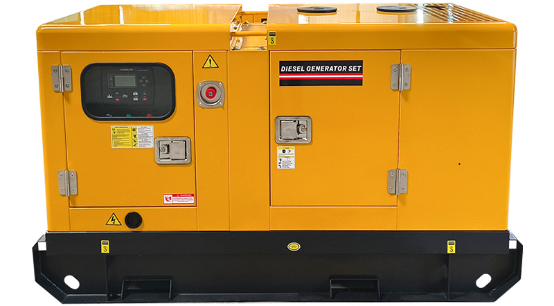
A 10-14kW silent diesel generator — the workhorse class for single-shelter tower sites where the genset runs close to the real load for hours at a time.
On a tower site the control module is the operator. It has to make the right decision every day without supervision, so its behaviour — not the engine badge — should drive the buying decision.
The essential sequence: detect mains failure, signal the tower's battery-backed DC plant to bridge, crank the engine, confirm oil pressure and charge alternator output, close the contactor or transfer switch, and take the load. On mains return, run a timed cool-down so the turbocharger and exhaust cool under decreasing load, then open the circuit and stop. Add to this: crank disconnect, over-crank lockout with a retry limit, low oil pressure and high coolant temperature shutdown, overspeed protection, battery charging while standby, and a weekly exercising schedule that actually places load on the engine rather than idling it.
A controller with an SMS or 4G data connection turns the genset from a black box into an instrumented asset. The operations centre should see: mains present or absent, generator running or stopped, voltage and frequency, engine hours, fuel level, coolant temperature and battery voltage, plus alarm and shutdown events with timestamps. Fuel-level telemetry alone pays for itself in markets where pilferage is the number one operating cost. When comparing offers from any diesel power generator supplier, ask which controller brand is fitted, whether the modem is internal or bolted on, and whether the event log survives a power interruption — cheap controllers lose their history exactly when you need it.
More tower-site genset failures trace to starting batteries than to engines. Specify a maintenance-free battery, a dedicated float charger inside the canopy, low-battery-voltage alarms to the NOC, and engine block heater power where winters bite. A set that cannot crank is indistinguishable from a set that does not exist.
Fuel is the largest lifetime cost of a telecom genset and the hardest to manage across hundreds of sites. The design question is not "how big is the tank" but "how many days can this site ride through a road closure, a refueller shortage or a billing dispute".
A diesel genset burns roughly 0.25 to 0.30 litres per kWh delivered. A 20 kW set carrying a realistic 12 kW site load therefore uses about 3 to 3.6 litres per hour, or 72 to 86 litres per day of continuous running. If the operating target is seven days of autonomy — a reasonable figure for remote sites — the base tank plus any external bulk tank must hold 500 to 600 litres. A site with a 48-hour target can live with a 200 litre day tank and a reliable refuelling contract; sites in conflict-affected or flood-prone regions should carry more.
Order a base fuel tank sized for the autonomy target, with a low-level alarm wired to the controller and a level sender visible to the NOC. Fill points must be lockable and positioned so the refuelling truck never needs to enter the equipment shelter area. Where ambient temperatures swing widely, a bunded tank with drainage matters: water condensation inside a half-empty tank is the classic cause of injector failure in remote sets. Fuel polishing or biocide dosing belongs in the maintenance contract, because fuel that sits for months degrades whether the engine runs or not.
Fuel theft is the telecom industry's quiet tax. Practical countermeasures: lockable anti-siphon fill points, internal tank with no external gravity outlet, level telemetry with out-of-hours draw alarms, and locating the genset inside a fenced compound behind the shelter rather than beside the boundary wall. Every one of these is cheaper than a single season of losses.
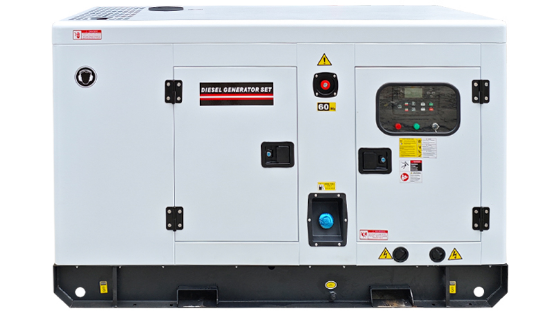
A 32kW canopy diesel generator — weatherproof enclosure, lockable fill and compact footprint suit unattended tower compounds.
A canopy diesel generator in the 10–80 kW range is the standard telecom answer: weatherproof, sound-attenuated to roughly 70–75 dB(A) at seven metres, small enough to fit a compound corner, and secure with a lockable canopy. In residential-adjacent and rooftop sites, insist on a genuinely silent version — around 65–70 dB(A) — because complaints close sites faster than outages do. Verify that the enclosure carries the full weight of tank, batteries and controller, and that louvres are designed for the airflow the radiator actually needs; a canopy that runs hot will derate the engine in exactly the months when cooling load is highest.
During network rollout, before mains reaches a new site, a trailer type construction site generator keeps crews and temporary shelters running and then moves on to the next cluster. Rental-style trailers with road lights, brakes and a towing eye also make economical maintenance swaps: when a fixed site's set goes down, a trailer unit takes the load while the repair happens at the workshop. Longhong builds mobile trailer diesel generator formats across the same engine platforms as the fixed range, which keeps the spares list common.
Where several shelters, a data room and transmission gear concentrate on one plot, a containerized diesel generator with internal lighting, power outlets, a day tank and space for a second unit gives the site a proper plant room outdoors. This format also scales: a hub sized today for a 100 kW set can accept a second paralleled unit later without civil works. For reference on how containerized and canopy packages behave at industrial scale, see the full diesel generator product catalog and the company's 100KVA Cummins export installation in Tanzania, a documented telecom-and-commercial power project.
The tower's DC battery plant and the genset are one system, and the design of one changes the duty of the other.
On mains failure the rectifiers keep feeding the radios from batteries while the genset cranks — typically 10 to 15 seconds from detection to load acceptance. Design the bridge so batteries cover crank time plus one failed-start attempt: that is 5 to 15 minutes of real autonomy at most, which is why the generator's start reliability is life-or-death. Conversely, avoid transferring the full AC load in one block onto a cold set at altitude or in extreme cold; staged transfer or a brief warm-up is worth specifying for high sites.
After a long outage, drained batteries impose a recharge current well above normal site load. Size the genset for site load plus recharge, or set the rectifiers' recharge limit below the genset's headroom — otherwise the generator trips on overload exactly once per outage, which is the worst possible moment.
Solar-hybrid sites cycle the diesel less, which is good for fuel and bad for the engine if the genset only ever runs a few minutes a day. Where cyclic light-load running is unavoidable, schedule a monthly high-load exercise with a resistive load or a load bank to burn out deposits — the wet-stacking discipline applies as much to a 16 kW tower set as to a 1000 kVA industrial emergency diesel generator.
Telecom fleets are bought in batches and live in the field for a decade, so the sourcing decision is really a fleet decision. The checklist below reflects what separates a fleet that runs from a fleet that gets towed.
Insist on a witnessed or video factory acceptance test for the first units: cold start, stepped load to 100%, protection shutdowns, controller sequence demonstration, and a fuel consumption reading at a realistic load point. Then run a pilot — ten to twenty units across your worst sites — before committing the fleet. The pilot will find the issues no specification sheet lists: door seal quality, paint on coastal air, the controller modem's behaviour on the local network, and the parts your technicians actually consume.
One first-line service kit per ten units — filters, belts, coolant, contacts, starter solenoid — plus controller and starter spares per region, and a hands-on training session for the field maintenance crew. The supplier's company profile should tell you how long they have built this class of equipment and how they support export customers after the container lands; a manufacturer that stocks 200+ units and ships to Southeast Asia and Africa on a routine basis has answered both questions in practice.
Telecom power is judged on one number: site availability. The genset that delivers it does not need to be the cheapest, the biggest or the quietest — it needs to be correctly sized, honestly controlled, fuelled for the real grid, and supported with parts. Buyers who specify those four things, and test them before the fleet ships, end up with the towers that stay on air.
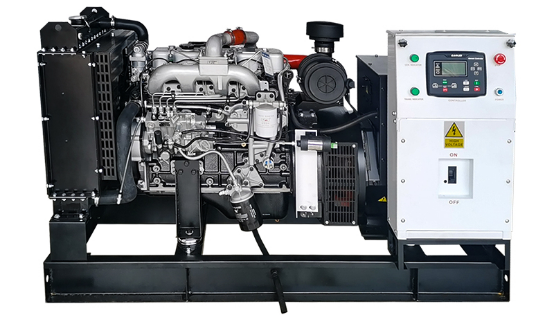
An open frame diesel generator set — the economical choice for temporary rollout power and workshop test duty, where sound attenuation is not required.
A base station generator succeeds or fails on details that never appear in a price comparison: the load band it will actually run at, the controller decisions it must make alone, the fuel it must carry between visits, and the enclosure that must survive the site. Size for 40–70% loading, demand a named auto-start controller with remote monitoring, carry seven days of fuel in remote areas, and buy prime-rated hardware from a manufacturer who will show you the test. Do those things and the batteries will only ever bridge the fifteen seconds the standards require — not the three days the grid was away.
Founded in 2010 in Guangdong, China, Guangdong Longhong Electromechanical Equipment Co., Ltd. is a diesel generator manufacturer offering open frame, silent canopy, trailer and containerized generator sets from 3KVA to 3000KVA, powered by Cummins, Weichai, Yuchai, Perkins, Volvo and Yunnei engines. CE and ISO certified, with 200+ units in permanent stock and exports to Cambodia, Vietnam, Myanmar, Tanzania, Libya and beyond. Explore the product range or request a telecom-site power specification today.


