

 English
 العربية
 Español
 Русский
Industry News
Industry News

When the utility grid fails at a data center, every second of downtime carries a measurable cost: dropped transactions, corrupted workloads, breached service-level agreements and, in the worst cases, permanent loss of client trust. A UPS system can bridge seconds, but only a properly sized standby diesel generator can carry an IT facility through an outage lasting minutes, hours or days. This guide explains how data center operators, colocation providers and edge-site managers can select the right diesel generator set in 2026 — from load assessment and tier requirements to ATS integration, fuel autonomy and factory sourcing. Guangdong Longhong Electromechanical Equipment Co., Ltd., a China diesel generator manufacturer with more than 20 years of experience, supplies standby diesel power generator solutions from 3 kVA to 3,000 kVA for critical facilities worldwide.
Data centers are among the most power-sensitive facilities in existence. Servers, storage arrays and network switches tolerate voltage and frequency deviations far less than a typical factory machine, and cooling must continue even when the grid does not. Unlike a small generator for home or a portable diesel generator on a construction site, a data center genset must start automatically, accept a large step load within seconds of the UPS expiring, and then run continuously for many hours without derating or stalling.
A complete backup power architecture has three layers, each covering a different time window:
The same three-layer logic protects other mission-critical buildings. Longhong has supplied a 500 KVA silent generator for a school campus, where classrooms, laboratories and dormitories depend on uninterrupted power — and the engineering principles are identical for server rooms in offices, hospitals and telecom huts. What changes is the load profile and the redundancy level the operator chooses to pay for.
Correct sizing is the single most important decision in the entire project. An undersized diesel genset trips or stalls when the UPS hands over the load; an oversized one wastes fuel, suffers wet stacking at light load and costs more to install. Before contacting any diesel generator supplier, work through the following steps.
Start with the rated IT load in kW, then add the facility overhead. Cooling typically consumes 30–40% of IT power depending on the design (expressed as PUE — power usage effectiveness). Add UPS conversion losses, lighting, security systems and office loads. A hall with 500 kW of IT equipment and a PUE of 1.5 therefore presents roughly 750 kW of total facility load to the generator.
Add 20–25% spare capacity for future IT expansion and measurement error, then decide the redundancy topology. A single genset with margin (N) suits small server rooms; N+1 — one additional unit than strictly needed — is the standard for enterprise and colocation sites, allowing maintenance without exposing the load. Two smaller generators in parallel often cost less and survive failures better than one large machine.
When the UPS transfers load to the generator, the engine must absorb near-rated load in one step without excessive frequency dip. Modern UPS rectifiers and variable-speed CRAH fans also inject harmonics that can overheat a marginal alternator. Specify an oversized or low-impedance alternator and share your UPS and cooling-load data with the manufacturer so the set is verified for the worst-case transfer, not just steady state. Data centers almost universally require a three-phase diesel generator; only tiny edge cabinets running single-phase IT gear can justify a single-phase diesel generator.
As a reference point, edge computing rooms and branch server rooms in the 60–90 kW range are well served by Longhong's 100 kW silent diesel generator and 80 kW silent diesel generator, both available with auto-start controllers and three-phase output.
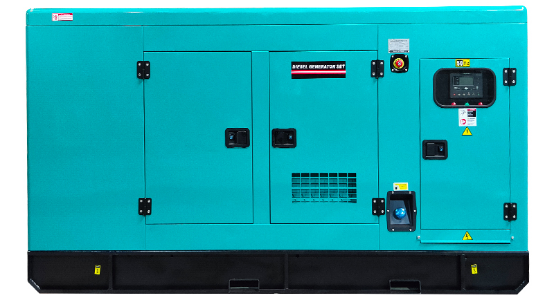
Once the rating is fixed, choose the enclosure style that matches the installation site. Each configuration trades noise, weather protection and cost differently.
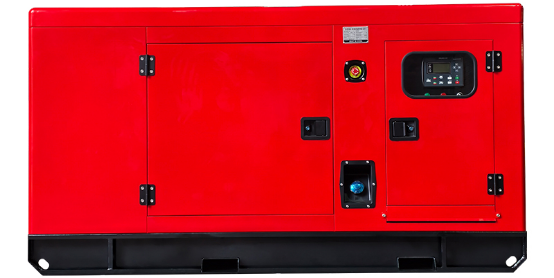
Most data centers stand in office districts or industrial parks with neighbors nearby, so a canopy diesel generator with sound-attenuated enclosure is the default choice. Quality canopies hold noise below 75 dB(A) at 7 meters and protect the engine from rain, dust and salt air. Smaller facilities — from a 40 kW network room to compact branch sites — can step down to a 32 kW silent diesel generator that shares the same low-noise enclosure design.
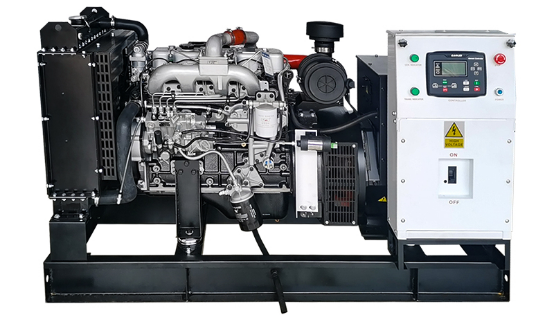
Where the generator lives in a purpose-built plant room with acoustic treatment and forced ventilation, an open frame set lowers cost and simplifies service access. The room must supply roughly 6–8 cubic meters of cooling air per minute per 100 kW of rating, and exhaust must be routed away from fresh-air intakes — a detail that matters as much as the genset itself.
Hyperscale and colocation campuses increasingly standardize on the containerized diesel generator: the genset, fuel system, controls and ventilation are factory-integrated into a 20- or 40-foot ISO container that can be craned into place, connected and commissioned in days. Containers simplify outdoor placement, scale cleanly as the white space grows, and can be configured as a multi-megawatt diesel power plant with paralleling switchgear. They also travel well — the same format Longhong exports for construction and mining projects serves modular data center builders.
In a data center, the generator is only as good as its control chain. When utility power fails, the sequence must run itself: the controller senses the outage, cranks the engine, stabilizes voltage and frequency, and signals the automatic transfer switch to connect the load — all within about 10–15 seconds, well inside the UPS autonomy window.
An open-transition ATS breaks the utility connection before closing the generator side; this brief (millisecond-level) interruption is invisible behind the UPS and keeps cost down. Closed-transition ATS synchronizes the two sources for a make-before-break transfer, useful where the facility also performs regular utility-to-generator load tests without disturbing IT equipment. For smaller sites, an integrated 64 kW automatic diesel generator with a built-in ATS cabinet is a practical, factory-tested package.
Modern controllers expose Ethernet, GSM and Modbus interfaces, letting the genset report fuel level, coolant temperature, oil pressure, battery status and load percentage directly into the building management system (BMS) or DCIM platform. Alarms for low fuel, failed start or overload should reach staff phones, not just a local panel. When comparing offers, check which controller brands, communication protocols and remote-start inputs the diesel power generator supports — retrofitting monitoring later is far more expensive than specifying it at the factory.
Installation planning determines whether the generator performs during its first real outage or fails for reasons unrelated to the machine itself.
Size the tank for full-load consumption, not average load, and set autonomy according to site criticality:
Include a bulk storage tank with a day tank, fuel level telemetry, water and sediment drains, and — in warm climates — fuel polishing or biocide dosing to keep diesel in condition. Diesel stored for years degrades; a generator with clean fuel is a reliable one.
Airflow is the most common installation mistake. Radiator discharge must not recirculate into the engine intake, and flexible connections should isolate engine vibration from ducting and pipework. Exhaust systems need insulated piping, rain caps and correct back-pressure limits. Where local ordinances cap site noise — as they do for shopping centers and hospitality projects that rely on the same shopping mall backup diesel genset and hotel diesel backup power generation equipment technology — select a super-silent canopy, orient the discharge away from receptors and verify the acoustic design before civil works begin.
A standby generator that never runs under real load is a hypothesis, not a guarantee. Data center operators should institutionalize testing from day one:
Light-load running causes wet stacking — unburned fuel and carbon accumulating in the exhaust system — so monthly tests should be meaningful, not token five-minute idles. Keep critical spares (filters, belts, coolant, batteries) on site, and contract response times with your supplier in writing. Facilities that document testing recover from real outages measurably faster than those that treat the genset as installed-and-forgotten.
China remains the world's largest production base for diesel generator set equipment, offering strong value, flexible configurations and short lead times — a significant advantage when a data center expansion is on a fixed commissioning schedule. To buy well, verify the following before placing an order:
Confirm that the Cummins, Weichai, Yuchai, Perkins, Volvo or Yunnei engine is new and genuine, with serial numbers and factory inspection reports traceable. The alternator brand, insulation class and voltage regulation accuracy (±1% or better for data center duty) should be documented in the offer, not promised verbally.
Review the manufacturer's certifications and qualifications: ISO 9001 for quality management, CE marking for European destinations, and destination-specific approvals where required. Buyers specifying a UK diesel genset or other 50 Hz European market should confirm voltage, frequency and grid-code documentation at quotation stage. Longhong holds CE and ISO certification and exports to Cambodia, Vietnam, Myanmar, Tanzania, Libya and beyond.
Request a witnessed or video-recorded FAT covering rated output, step-load response, protection trips and temperature rise before shipment. Manufacturers with 200+ units in permanent stock — as Longhong maintains — can often deliver standard ratings in days rather than months, keeping your construction schedule intact.
Ask where filters, injectors, controllers and AVR modules are stocked, what the warranty covers, and whether the factory can support remote commissioning or train your technicians. For mission-critical installations, a supplier who answers the phone after delivery is worth more than one who is 2% cheaper.
For campus-scale projects, units such as the 500 KVA Yuchai silent generator delivered for a critical facility illustrate the class of equipment involved — large kVA ratings, sound-attenuated enclosures and full monitoring, shipped and commissioned as a package.
A data center diesel generator is not an accessory; it is the final line of defense between the grid and your customers' workloads. Size it against the true facility load with growth margin and N+1 logic, choose the enclosure for the site, integrate auto-start controls with the UPS and BMS, plan fuel and airflow with discipline, and test under real load every month. Working with an experienced China diesel generator manufacturer turns these requirements into a buildable specification instead of a wishlist.
Guangdong Longhong Electromechanical Equipment Co., Ltd. builds open frame, silent canopy, mobile trailer and containerized emergency diesel generator sets from 3 kVA to 3,000 kVA, powered by Cummins, Weichai, Yuchai, Perkins, Volvo and Yunnei engines. With CE and ISO certification, 200+ units in permanent stock and export experience across Asia, Africa and the Middle East, Longhong helps data center and facility operators secure dependable power outage backup power generator capacity. Browse the product catalog or contact the team to size a genset for your server room or campus.


