

 English
 العربية
 Español
 Русский
Industry News
Industry News

Water and wastewater facilities are unlike almost any other backup power application. A shopping mall that loses electricity loses sales; a water treatment plant or pumping station that loses electricity can lose public health, environmental compliance and expensive equipment within hours. Untreated sewage overflowing into rivers, water intake pumps going silent, chlorine dosing systems failing — these are regulatory and liability events, not just inconveniences. That is why utilities, municipal contractors and EPC firms treat the diesel generator set at a water facility as critical infrastructure, not optional equipment. This guide explains, from a buyer's perspective, how to select, size and source an industrial emergency diesel generator for water treatment plants, booster stations, sewage lifting stations and desalination projects — including what to check when buying directly from a China diesel generator manufacturer.
Guangdong Longhong Electromechanical Equipment Co., Ltd. has supplied power generator solutions for municipal, industrial and export projects since 2010, with engine options from Cummins, Weichai, Yuchai, Perkins, Volvo and Yunnei in output ranges from 3KVA to 3000KVA.
Understanding the failure modes of a water facility explains why its generator specification is stricter than most industries.
Water distribution relies on pressure. Booster pumps and high-lift pumps must run continuously or storage towers and network pressure drop within minutes. On the wastewater side, sewage lifting stations have limited wet-well capacity; when pumps stop, sewage backs up into streets and homes. A power outage backup power generator sized for these loads must start and carry full pumping load quickly — typically within 10 to 15 seconds when feeding critical stations.
Biological treatment processes — activated sludge, aeration blowers, MBR systems — depend on continuous oxygen transfer. Aerobic biomass can begin to die within hours without aeration, and rebuilding a collapsed biomass takes days or weeks. During that period the plant may violate discharge permits every single day. An industrial emergency diesel generator protecting aeration and dosing systems is therefore protecting months of biological stability, not just a few hours of operation.
In most jurisdictions, sewage overflow and untreated discharge events must be reported and can trigger heavy fines. Insurers and regulators increasingly ask facility owners to document standby diesel generator capacity and monthly testing records. For private operators under BOT or PPP contracts, power-related service failures often convert directly into financial penalties.
Before comparing prices, buyers must define the duty class — the single biggest factor in generator cost and longevity.
Most urban water plants run on a reliable utility grid and need the generator only during outages. A standby-rated diesel genset is economical here: it is sized for emergency load, expected to run a few hundred hours per year, and its defining features are fast starting and dependable auto-start control rather than fuel economy.
Rural pumping stations, remote intakes and many projects in Africa, Southeast Asia and island communities run 8 to 20 hours per day on generator power because the grid is absent or unstable. These sites need a prime-rated power generator engineered for sustained load, with oversized cooling, heavy-duty alternators and realistic 70-80% loading targets. Buying a standby-rated unit for prime duty is the most common — and most expensive — specification mistake in this sector, because it halves effective service life.
Many new water projects combine solar arrays with diesel power plant capacity. The diesel generator must then tolerate wide load swings and frequent starts, and buyers should confirm the governing system supports stable operation at low load in parallel with inverters. Discuss your hybrid architecture with the factory before ordering rather than after delivery.
Sizing for water facilities is dominated by one factor buyers often underestimate: electric motor starting current.
List every load: raw sewage pumps, aeration blowers, chemical dosing pumps, UV or chlorination systems, SCADA and lighting. Note each motor's rated power and starting method. Across-the-line starting draws 6-8 times rated current; a star-delta starter draws roughly 3-4 times; a soft starter or VFD can be reduced to 1.5-2 times. Two 30 kW pumps started across-the-line need a far larger diesel generator set than the same pumps on soft starters.
Work with your electrical engineer to stagger motor starts: largest motor first, then descending. With proper sequencing and soft starters, a station with 150 kW of connected pump load often runs comfortably on a 160-200 kW class genset instead of a 300 kW unit — a saving that pays for the soft starters twice over.
Add 10-20% for ambient temperature, altitude and future load growth. If the station sits above 1000 meters or in sustained 40°C heat, tell the factory — cooling packages and turbocharger ratings change. For a typical district wastewater plant in the 100 kW class, a proven configuration is a three-phase diesel generator around this rating; see the 100kW diesel generator as a reference unit, or the 80kW silent diesel generator for compact station rooms. Smaller rural lift stations frequently fall in the 20-40 kW range, where the 40kW export diesel generator and 32kW silent generator are common choices for municipal contractors.
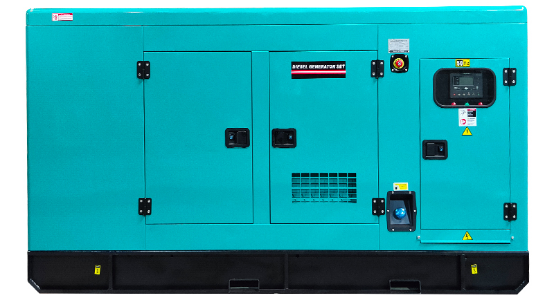
A 100kW silent diesel generator set — a typical backup rating for district-level water and wastewater stations.
Water facilities are usually unstaffed at night. Nobody is there to press a start button, so automation is not a luxury.
The generator controller must sense utility failure, start the engine, stabilize voltage and frequency, and signal the ATS to transfer — all within seconds. Modern 64kW automatic generator class units and above ship with electronic controllers supporting programmable start sequences, crank cycles and configurable ATS outputs. Confirm the controller brand (SmartGen, Deep Sea, ComAp are the industry standards) and that it supports two-wire remote start, which allows the genset to be commanded by the plant's own SCADA system.
Because stations are scattered across a service territory, utilities increasingly specify GSM/4G monitoring modules that push alarms — fail to start, low fuel, high coolant temperature, controller events — to a central dashboard or mobile phones. When evaluating a China diesel generator manufacturer, ask whether the monitoring gateway is factory-fitted and tested with the controller, and request the alarm point list in writing.
Rule of thumb: a diesel genset at 75% load consumes roughly 0.25-0.30 liters per kWh produced. A 100 kW unit running a 24-hour outage therefore needs a base tank plus external supply around 600-700 liters. For remote stations, buyers should specify an enlarged long-range base fuel tank at order time — retrofitting tanks after installation is costly.
Water facilities mix residential neighborhoods, open fields and plant rooms, so enclosure choice directly affects permitting and neighbor relations.
A canopy diesel generator with 65-75 dB(A) at 7 meters suits booster stations and sewage lifting stations located near housing. Weatherproof canopies also protect against rain and dust for outdoor installations where no building exists. For compact rural pump houses, units such as the 24kW silent diesel generator and 20kW silent diesel generator keep footprint and noise minimal while still supporting auto-start control.
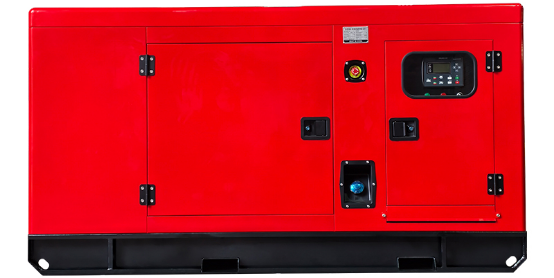
80kW silent canopy diesel generator — weatherproof and noise-controlled for stations close to residential areas.
Large plants needing 500 kW to multi-megawatt capacity often choose a containerized diesel generator: it ships as standard ISO freight, arrives pre-wired and tested, resists vandalism, and integrates fuel tanks, ventilation and fire suppression in one enclosure. For export projects in Africa and the Middle East, containerized packaging also dramatically simplifies site labor — a real advantage where skilled technicians are scarce.
Where the facility already has a ventilated, weather-protected generator room, an open frame diesel generator reduces cost and simplifies maintenance access. Ensure the room design provides combustion air and radiator ducting per the factory's installation drawings.
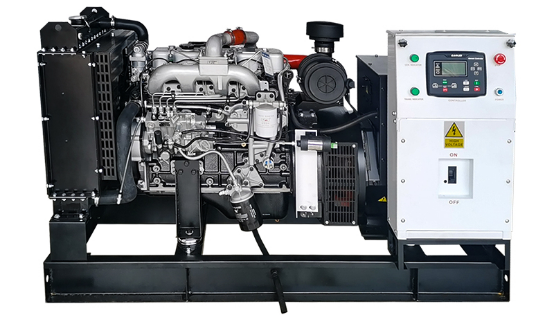
Open frame diesel generator set — the economical choice where a dedicated generator room already exists.
Water facilities are wet environments. Specify tropical radiators, anti-corrosion canopy coatings, elevated bases above expected flood lines and sealed control panels. Alternator insulation class H with IP23 protection as a minimum is advisable; for humid coastal or underground chambers, discuss space heaters that keep windings dry.
Municipal stations frequently sit meters from homes. Beyond choosing canopy enclosures, buyers can specify residential-grade exhaust silencers and, where needed, additional acoustic louver sets. Noise limits should be written into the purchase contract with measurable acceptance criteria — a supplier confident in its engineering will agree.
Check which emission stage your jurisdiction requires before ordering; export units can be configured for the appropriate tier. Also confirm the engine tolerates local diesel quality — in many export markets fuel filtration upgrades are worth the modest cost. Longhong documents engine certification details on its qualifications and certificates page, including CE and ISO credentials buyers can verify before contracting.
Ask for: engine and alternator nameplate specifications (not just "Cummins powered" claims), the controller model and alarm list, alternator winding and AVR details, canopy noise test reports, and factory acceptance test (FAT) videos or an invitation to witness testing. A manufacturer with its own production lines and permanent stock — Longhong keeps 200+ units across its product catalog — can typically deliver standard ratings within days rather than months, which matters when a project schedule is tied to a procurement deadline.
Cummins, Perkins and Volvo have global parts networks ideal for buyers without strong local service; Weichai, Yuchai and Yunnei offer excellent value and strong support across Asia, Africa and Latin America. The right question is not "which brand is best" but "which brand can my team service for the next ten years." Real-world references help: Longhong's exported units include a 100KVA Cummins genset delivered to Tanzania and a 400KW Yuchai silent generator serving a large industrial load — examples of ratings and configurations comparable to municipal duty.
Write these into the purchase contract: exact model and engine/alternator serials, duty rating, noise level, tank capacity, controller and monitoring configuration, spare parts starter kit (filters, belts, coolant), packing and shipping terms, and warranty length with defined response commitments. Buyers who skip this step discover gaps at commissioning; buyers who include it receive a package their operators can run from day one. To discuss a water-project specification directly, contact the team via the company profile and contact page.
A diesel generator for a water treatment plant or pumping station is specified by three things: correct duty class, motor-start-aware sizing, and automation that works without human presence. Get those right, choose the enclosure that matches the site, and buy from a manufacturer willing to put test data and certifications in writing. Facilities that follow this process keep clean water flowing and permits intact through every grid outage — at a total cost far below the fines and repairs of a single failure.
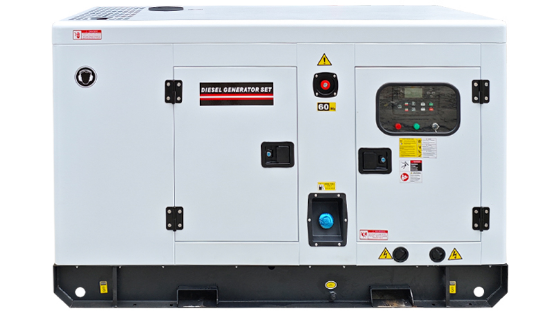
32kW silent diesel generator — a compact auto-start option for rural lift stations and small intakes.
About Guangdong Longhong Electromechanical Equipment Co., Ltd. — Founded in 2010 in Guangdong, China, Longhong is a diesel generator manufacturer with 20+ years of engineering experience, offering generator sets from 3KVA to 3000KVA powered by Cummins, Weichai, Yuchai, Perkins, Volvo and Yunnei engines. Products include open frame, silent/canopy, trailer and containerized types, CE and ISO certified, with 200+ units in permanent stock and exports to Cambodia, Vietnam, Myanmar, Tanzania, Libya and beyond. Visit https://www.longhongpower.com/ for the full range and quotations.


